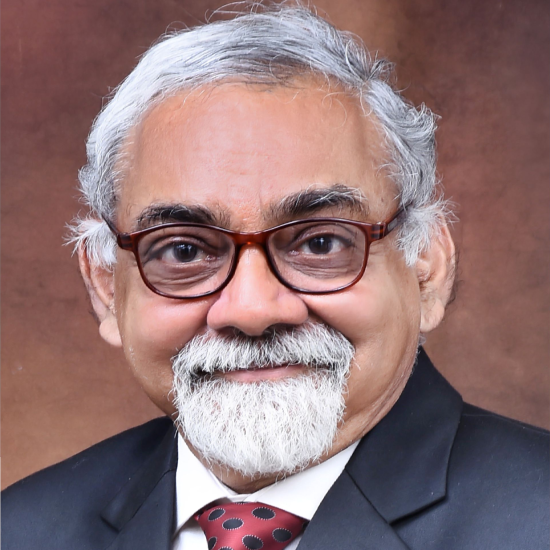
A Literary Journey
The life of Rajiv Khandelwal spans education, entrepreneurship, literature, music, and creative pedagogy. His work reflects a sustained engagement with language and learning across several decades.
The Early Years (Kanpur)
Rajiv Khandelwal was born on 7 March 1957 in Kanpur. Shortly after birth he was handed into the care of his maternal grandparents in Kanpur, where he was brought up until 1968. The convent school education of those years, in Kanpur's disciplined, English-medium environment, gave him his first serious encounter with the language in which he would eventually write.
In 1969, at the age of eleven, he was sent to Agra. His grandmother died the following year. He was admitted to St. George's School, Agra, one of the city's oldest English-medium institutions, and studied there for five years.
The Formation (St. George's School,Agra)
At St. George's, Khandelwal sat the Indian School Certificate Examination in 1973 under the aegis of the University of Cambridge Local Examinations Syndicate, passing in the First Division. His highest mark was in Literature in English, with 80 out of 100, a subject that would find its way back to him two decades later, by a route he had not anticipated.
The gap between the Literature in English mark and the English Language mark is itself instructive: a strong feel for literary texts alongside a weaker grip on the formal mechanics of language. The curriculum that would occupy his later years argues that these two things must be taught together. The ISC mark sheet suggests the separation was felt from the beginning.
Alongside his studies, he was active in debates, elocution, dramatics, and sport. The engagement with language and performance was serious and sustained, and it left a longer trace than the examination results alone suggested.
The College Years (BIT Mesra and the Creative Thread)
In 1974, Khandelwal entered the Birla Institute of Technology, Mesra, Ranchi, to read Electrical Engineering. BIT Mesra was then, as now, one of India's most competitive technical institutions. What is less obvious from the engineering record is that the arts ran alongside the technical training throughout those years.
In 1975, he was part of the team that won the Best Team Prize in the Inter-Hostel Drama Competition at BIT Mesra and received a special mention for his individual contribution. In 1976, he was adjudged Best Actor in the Inter-Hostel Dramatics competition, and represented BIT Mesra at Mood Indigo, the cultural festival of IIT Bombay, and at Spring Fest at IIT Kharagpur, both in English plays. In 1978, the group vocal music team of which he was a member secured first position in Rhythm-78 at BIT Mesra.
These are not footnotes to an engineering career. They are evidence of a young man for whom language, performance, and creativity were serious commitments running alongside the technical discipline that would define his professional life for the years that followed.
The Kanpur Interlude and the Return to Agra
After graduating from BIT Mesra, Khandelwal returned not to Agra but to Kanpur, where he worked for two years, from 1980 to 1982, in his grandfather and uncle's factory. The years in Kanpur completed a circle: the city where his grandparents had raised him became the city where his working life began.
In 1982 he returned to Agra, and has lived there since. The return was a settling. Agra has been his home, his base, and the ground from which everything that followed, the business, the community work, the writing, the curriculum, has grown.
The Professional Years (Business and Civic Life)
In Agra, Khandelwal built a career in business through G.R. Exports, based at 22/3 Pandit Motilal Nehru Road, Agra. He is, as he has described himself, fundamentally a businessperson. The engineering qualification formed the technical foundation; the business years shaped the discipline and the organisational capacity that would later inform the construction of an eleven-volume curriculum.
In 1984 he joined the Jaycees, becoming a National Trainer in 1989. He has served Lions Clubs International since 1992, holding positions including Club President, District Youth Exchange Chairperson, and multiple District Chairperson roles over two decades, a sustained commitment to community leadership that ran in parallel with the business career and, eventually, with the poetry.
In 1986, he co-produced a documentary film titled Visit India, Discover Agra, a creative act that predates the poetry by nearly a decade and confirms that the artistic impulse was present throughout the professional years, looking for its form.
The Return to Literature
In 1995, Khandelwal began writing poetry. He was thirty-eight years old. The occasion was specific: his elder daughter had been sent to a boarding school in Shimla, and her letters home prompted replies in verse. What began as correspondence became a practice, and quickly a serious one.
DECEMBER 1996 — FIRST ACCEPTANCEBy December 1996, a Hindi poem written to his daughter had been accepted for publication by Vaicharikee, a literary magazine based in New Delhi, edited by Monika Mohini. The poem that began everything was also the first poem to find a publisher. The editor's handwritten note on the acceptance letter confirmed the poem had been selected and asked for a photograph and biographical note.
JANUARY 1997 — DR P. LAL'S LETTER
In January 1997, he sent early poems to Dr P. Lal, founder of Writers Workshop, Calcutta, one of the most important publishing houses in the history of Indian English literature, for critical comment. Dr P. Lal's response, written on Writers Workshop letterhead and dated 13 January 1997, was unsparing and precise.
The comment did not discourage. It directed. Dr P. Lal also recommended Bose and Sterling's Rhetoric and Prosody, the book taught in English Honours classes at Calcutta University, as the foundation text for learning prosody. The letter, preserved in the author's papers, is the biographical hinge between the early practice and the serious study that followed.
Before the Manchester enrolment, the work was already appearing in national print. In March 1997, 'Naked Truth' was published in Femina, a Times of India publication and one of India's most widely read English-language magazines. In the 15 July 1997 issue, three further poems appeared: 'Definitions', 'A Tiff', and 'Crying'. A fee was paid for both publications.
SUMMER 1997 — THE POETRY SOCIETY (INDIA)In the Summer 1997 issue of The Journal of The Poetry Society (India), Volume 8, No. 1, three poems appeared: 'Our Friendship', 'Battle of Independence', and 'Mortgaged'. The journal's editor at that time was Ajit Khullar. The board included President J.P. Das and Vice-President Keki N. Daruwalla, one of the most celebrated Indian English poets of the twentieth century and a recipient of the Sahitya Akademi Award and the Commonwealth Poetry Prize. In his submission consideration letter dated 9 August 1997, Ajit Khullar wrote: “You Write Well”. An editor does not give three poems to a writer in a single issue, or write those words on the acceptance, without a considered positive judgement.
JULY 1997 — MANCHESTER
In July 1997, at the age of forty, Khandelwal enrolled as a student at The Writers College, Manchester, student number 30725, committing to a formal course of study in the craft. The enrolment came six months after Dr P. Lal's letter and in the same season as the Poetry Society (India) acceptance. It was not the act of a discouraged beginner seeking remedy. It was the act of a writer already in motion, choosing to deepen the foundation systematically.
His engineering training informs the choice: a person who understands that complex structures require sound foundations does not wait for intuition to supply what method can build. The Writers College, Manchester provided the craft framework that the early practice had been developing without.
On 1 January 1998, writing on G.R. Exports letterhead, Khandelwal sent a Demand Draft of USD 97.45 to Writers Digest Books, Cincinnati, Ohio, ordering five specialist volumes: The Art and Craft of Poetry, Creating Poetry, The Poets Handbook, The Poets Dictionary, and The Idea Catcher. At the exchange rate of that period, this was a substantial personal investment. It is the act of a person who takes the craft seriously enough to pay for the best available resources from the world's leading poetry publishing house in the United States.
1997-1998 — FURTHER PRE-PUBLICATION APPEARANCESAlongside Femina and The Poetry Society (India) journal, poems appeared in Urdu Alive across 1996 and 1997, in First Time (UK Edition 34, Spring 1998), in Poetry Today (January-March 1998), and across three consecutive issues of Sun in early 1998. The pre-publication record for the debut collection spans ten named publications in India and the United Kingdom.
1998 — THE FIRST COLLECTIONConch Shells and Cowries was published in 1998 by Indian Publishers Distributors, New Delhi. By the time it appeared, twenty-two of its poems had already been published in ten named publications across India and the United Kingdom. This was not a debut from a standing start. It was the first collected volume of a practice that had been in motion for three years and had already attracted editorial recognition at the highest levels of the Indian English literary world.
The Mentors
The following year, in 1996, Khandelwal metDr Som P. Ranchan, scholar, poet, novelist, and literary critic, whose engagement with the early poems provided the critical framework that a self-taught writer needed. Dr Ranchan's influence on Khandelwal's development as a poet was formative and sustained. Through Dr Ranchan, Khandelwal was introduced to Dr Bhupinder Parihar, poet, critic, and translator, whose engagement with the work deepened over the years that followed. Dr Parihar would go on to select sixty poems from the body of work and translate them into Hindi, producing Kitna Kathin Hai Prem, published in 2021, and has remained a mentor and advisor since. Later, Khandelwal came into contact with Dr Shobha Diwakar, poet, scholar, and critic, who became another significant mentor in his literary life.
Dr Som P. Ranchan died in 2014. He left behind not only the first critical book on Khandelwal's work but frameworks on imagination taxonomy and formal linguistics that continue to inform the upper volumes of The Let's Series. His presence in the work did not end with his death.
The Body of Work
Seven adult poetry collections have followed across nearly three decades, from Conch Shells and Cowries in 1998 to Crystalline Tidings in 2025. The work has been translated into five languages: Romani, Chinese, Hindi, Korean, and Arabic. Selected poems appear in the syllabi of St. Aloysius' College, Jabalpur, a NAAC A+ accredited institution, and have been the subject of two MA dissertations at the same college. Nine full-length critical books have been written about the poetry by scholars across India and abroad, and a peer-reviewed journal devoted a special issue to the literary work in 2022.
Alongside the poetry, Khandelwal has published a children's poetry trilogy, Adventure, Crazy Class, and Magic Moments, all in 2021, and a debut novel, A Summer Spree (Ukiyoto, 2024), subsequently translated into Arabic as Mughamara Sayfiya (2025). He has compiled and edited two anthologies of Indian English poetry. He has been invited to read his work by the Sahitya Akademi, New Delhi, by the Sikkim Akademi, and by literary organisations in Australia.
He is Chief Advisor at Afflatus Creations, a peer-reviewed multidisciplinary literary journal, and teaches poetry writing through Sharp Brains Education.
The Let's Series
The Let's Series is the synthesis of everything the professional and poetic careers produced. A curriculum built by an engineer who understands systems, a businessman who understands how learning must be structured to be useful, and a poet who learned the craft as an adult and therefore knows precisely where the difficulty lives: these are not separate qualifications. They are the same qualification, arrived at from three directions.
The series spans eleven volumes and a professional companion, addressing learners from age ten to the practising poet. It proceeds from the conviction that grammar and poetry are not separate subjects but a single discipline, and that a learner who understands both together writes with greater freedom and precision than one who has studied them apart. The first volume, Let's Crawl, has been published by The Poetry Society of India, Gurugram (ISBN 978-81-949206-8-7). The remaining ten volumes are in final preparation for publication
Home and Continuing Work
Khandelwal has lived in Agra since 1982. The city of the Taj Mahal is also a city of trade, of Mughal history, of the Yamuna, and of the particular quality of light that the plains of Uttar Pradesh produce at certain hours. It is the city whose streets appear in the poems, whose rhythms have shaped the writing, and from which the correspondence with a daughter in the Himalayan foothills once travelled north by post.
He continues to write. His current interests include vocal music, for which he takes coaching, and the completion of The Let's Series.