Conch Shells and Cowries
The opening volume of the Adult Poetry Collection invites readers and aspiring writers to deepen their poetic expression through rich vocabulary, reflective thinking, rhythm, observation, and thoughtfully structured creative exercises.
About the Book
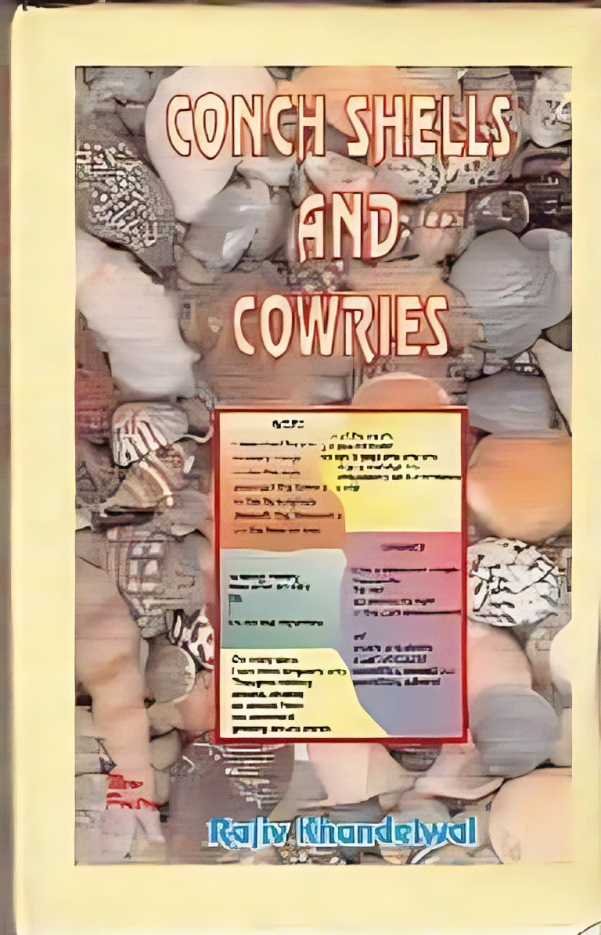
Conch Shells and Cowries is Rajiv Khandelwal’s first collection of poems, written through the closing years of the 1990s and reissued in a second edition in 2017. The book began without any plan to become one. When his elder daughter Vertica was sent to boarding school in Shimla, her homesick letters drew occasional verse out of her father in reply. Those replies, and a chance meeting soon afterward with the poet, scholar, and critic Dr Som Ranchan, who became his first mentor and later wrote the Foreword to this volume, persuaded him to keep writing.
The collection opens in the register of love, tender, wistful, sometimes self-mocking, often turning inward, as in ‘Word’, to ask what survives of feeling once it has been put into language. It does not stay there. Khandelwal turns next to the world around him, to the small frictions of school admissions and shopping lists, to the position of Indian women inside marriage and family, and to a society he finds, by turns, hypocritical and tender. The closing poems return to the personal, among them ‘To a Darling Daughter’, written for the daughter whose letters had started it all.
Sixty-three poems make up this debut, the first collection in a published record that would go on to span seven volumes over the next three decades.
PRAISE AND CRITICAL ACCLAIM
"Khandelwal has pedalled well in his debut book of verses assuming the role of a social reformer by making an exposé of the social evils and hypocrisy of the self-styled messiahs of the society through his tool of satire."
Dr D. C. Chambial | Editor, Poetcrit"What is distinctive about Khandelwal is that he quite strikes at the amalgamation of his diverse experiences including the literary ones in Conch Shells and Cowries almost complying with Eliot’s precept. Khandelwal’s literary resource is intense and powerful. Ushering in an extra-literary air into Indo-English, he holds good promise in his poetic pursuit."
Manohar Bandopadhyay | as published in Sun, August 7–21, 1998"The poems in Conch Shells and Cowries make good reading and are a creditable attempt on the part of Rajiv Khandelwal. They are very close to life; come from the heart and go to the heart. Indian English muse will definitely feel enriched by this contribution."
Dr Mita Biswas | Retired Professor of English, ICDEOL, Himachal Pradesh University, Shimla"The close perusal of poems in Conch Shells and Cowries reveal that Khandelwal is a poet of many excellences and his poetry is as varied as life and as vivacious as morning sun. The freshness of expression and chiseled style adds to the charm of his poetry."
Dr Shaleen Singh | Asst. Professor and Head, Department of English, S.S.P.G. College, Shajahanpur"An original voice with distinct idiom, terse, scintillating, at times elliptical, mirroring upper crusts shenanigans, corruption, material, moral, psychic with satire and punch, and surreal inner states with viscosity and brevity."
Dr Som Ranchan | Scholar, Poet, Novelist, Literary CriticReviewed by
- Manohar Bandopadhyay — ‘On Trail of Pound and Eliot’.
- Dr Mita Biswas — ‘Poet of Finer Human Aspirations’.
- Dr D. C. Chambial — ‘Khandelwal’s Poetry: A Study in Social Reality’ — Click here to read this review.
- Braja Chattopadyay — ‘Varied Colours and Designs’.
-
Dr Shobha Diwakar | C. P. Mahila Mahavidhyalaya, Jabalpur, M.P. | 'Bridging the Gulf: A Critique Rajiv Khandelwal's Conch Shells and Cowries Reference: Love Poem, Word' | Creative Saplings, Vol. 1, No. 01, April 2022, ISSN 0974-536X, Pages 33–41, DOI: 10.56062/gtrs.2022.1.1.5.
Click here to read this review & Also available at : https://creativesaplings.in/index.php/1/article/view/30 - Dr M. B. Gaijan — ‘Rajiv Khandelwal’s Conch Shells and Cowries: The Portrayal of Contemporary Concerns’ .
- Dr Bhupinder Aziz Parihar — ‘Relocating the Self: Conch Shells and Cowries — A New Beginning’.
- Dr VVB Rama Rao — ‘The Anatomy of Love’.
- Dr Priti Kumar Roy Choudhury — ‘A Reading of Conch Shells and Cowries’.
- Dr Anshu Sharma and Dr Ram Shankar — ‘Thematic Analysis of Rajiv Khandelwal’s Poetry’.
- Dr Shaleen Kumar Singh — ‘Poet of Many Shades’.
- Dr Pratibha Verma — ‘A Must-Read Volume’.
Khandelwal's Poetry: A Study in Social Reality
A critical appreciation of Conch Shells and Cowries by Dr. D. C. Chambial.
Rajiv Khandelwal, an Electrical Engineer from BIT, a businessman who deals in manufacturing and exporting automotive rubber components, is also a contemporary poet from Agra. He started his poetic journey by dabbling in verses in his college life; first published in Urdu Alive in 1996, and found the first encouragement from Prof. Som P. Ranchan, a poet and critic of world renown. Prof. Ranchan’s words enthused new spirit with added verve in the young poet to continue with his poetic journey. His poems, published in various magazines of renown, were brought out in book form in 1998, and came to the hands of the present critic only in May 2011, though having met him first in Gangtok in 2005. The varied themes of love and other evils prevalent in the society have attracted his careful poetic imagination. In this paper, the author makes an attempt to study his poetry in the light of his social realism as manifest in his book,
Conch Shells and Cowries
During the age of Romanticism, the poets lived in their ivory towers and composed their poems that were far removed from the people, society, and social problems. Now the poet has awakened to social reality and cannot remain blind to what is happening in his milieu and how his heart and mind react to it.
This all finds expression in Khandelwal’s verses that he composes, though in his calm but inspired moments, far from the madding crowds and cacophony of city life. Khandelwal, though living in Agra, the hub of business activities besides being a world-famous place for the Taj, is verily influenced by the love of Shahjahan for Mumtaz of which the Taj is a living monument. Let love be deferred till some other moment and the attention fixed on his concern for the society as he has mirrored it in his word-pictures for the readers.
Here, it will be pertinent to quote from M. H. Abrams what he thinks about satire, an important tool in the hands of a social realist:
"Satire is the literary art of diminishing a subject by making it ridiculous and evoking toward it attitudes of amusement, contempt, indignation, or scorn. It differs from the comic in that comedy evokes laughter as an end in itself, while satire ‘derides’; that is, it uses laughter as a weapon, and against a butt existing outside the work itself. That butt may be an individual …, or a type of a person, a class, an institution, a nation."
‘Search and Destroy’ is his first poem, written after reading a newspaper report that Vietnam had banned the use of foreign words; it embraces social realism as its theme. Though it concerns a country far away from India, the happenings there could not pass unnoticed from his imaginative mind. His protest against such a ban on language and ideas is evinced in this poem:
The pen declared war when the invaders breaking all territorial barriers entered Hanoi Though neither similes nor metaphors symbols, meters or free verses were their permanent allies yet the sword of irony with a biting edge showered a reign of terror Hanoi in retaliation declared them renegades to be banned and terminated with extreme prejudice The rulers in Hanoi sensed that the use of foreign languages was deeply influencing the lives and sensibility of the Vietnamese people; the Vietnam government decided to ban their use. These foreign languages, in the language of the poet, were considered as traitors to be banished from the land. In its shadow, his imagination and concern return to his native land in the poem, ‘Ask Me No More’, and he voices his resentment in these words: Ask me no more why honorable men raise public clamour in the lingua franca of silence at the murder of democracy?
The persona in the poem feels hurt at the sight of the ghastly murder of Indian democracy, and the politicians who have been entrusted by the masses to respect the country’s law and rule according to the wishes of the people have become its murderers.
One seeks some means to escape from dejection in life. The persona in ‘Of Late’ is in such a dilemma and wants to forget his present misery and has sought solace in wine. He admits that he has become a “practising follower / of Bacchus” (30). However, he knows well that it is not good and writes that “such demonic / feelings” have created “waves in the ocean of my psyche”. This sense of loss amalgamated with despair has gripped his mind. He is unable to forget it despite his best efforts, and before he took to this addiction he “was free / from any feeling of guilt”. This sense of guilt has “added to my woe”. It has not helped him in any way to mitigate his suffering, instead augmenting it. He avers:
And when to weed them out I sit with a drink in my hand contemplating the course of action a chain reaction triggers and like a nuclear fission the guilt feelings explode in the myriad of colours and proportion.
The protagonist justifiably realises that wine is no remedy to any problem. From this realisation he begins to meditate upon life in the eponymous poem, ‘Life’, and apprehends: “In the vast expanse of life / the eerie silence / the stillness / forebodes the arrival of the Storm” (33). The poet has used the word ‘storm’ with a capital S to evince its enormity. The situation in mind is something real and large that has been teasing persistently.
Contemporary politics also seems a tangible subject for poetic contemplation. In ‘Beyond the Pale’, the poet begins with a bitter sarcastic comment: “Politicisation of Criminals / Criminalisation of politics”, because he feels hurt with the criminalisation of politics. The criminals, in order to render the law of the land ineffective, seek elections on the sheer strength of their criminality and money. The poor voters are threatened with dire consequences. They are left with no alternative but to vote for such neo-politicians. By being elected to the Legislatures and Parliament of the country, they put on a mask of immunity from the law and become free to indulge in any unlawful activity: from murder to corruption of any dimension and nature. The poet furthers his thesis by arguing that they are “Brothers in Arms, / cleansing each other’s dirty duds”. Such polity, synchronising with the Satan’s tribe, is always busy in “cooking tales, / trying image laundering,” presenting themselves before the masses as white as milk. They have stultified politics to such an extent that it becomes “a herculean task for any Gandhian”.
He comes to satirise such leaders who differ in their words and actions. In ‘Crying’, he begins the poem with words in their stark nudity. The complete poem lays bare the hypocrisy of the messiahs of the nation:
When rapists and scam tainted give a talk from the heights of their makeshift dais on individual rectitude Commercial integrity under applause of thousands of listeners I laugh When a retiring professor involved in Sex scandals gets honoured as an exemplary emblem of character amongst an exclusive gathering of the cognoscenti I laugh When the corrupt find the corrupted too corrupt and stage competition to find who is the most corrupt of them all I laugh When an old man of fifty-six by Rs thousand gets bribed for a vasectomy and the next day’s newspaper lauding the efforts of the Government to combat the menace of population I laugh When the radio blares “Saare jahaan Se Achha Hai Hindustan Humara” I laugh
The poem is apparent in its accusations: rapes, scams, sex scandals, corruption of every kind, applause for meaningless and worthless deeds make the persona laugh. There is nothing that needs critical explication but the stark social reality that stares at the helpless masses. At the face of all these lapses, the song that goes into the air further accentuates the blatant inherent satire and irony of the nation’s fate.
In such an ambience, the poet also takes religious fanaticism and communal disharmony within the ambit of his poetic imagination in ‘Open the Windows’. He advises Hindu and Muslim fanatics to develop communal harmony, instead of thinking about rebuilding demolished structures at Ayodhya. He proposes to both communities:
Do not just think of rebuilding the destroyed walls of Mosques and temples rebuild the bridge of faith amongst the people
In this poem, the poet has in mind the demolition of Babri Mosque in Ayodhya in 1992. He suggests that instead of rebuilding structures of concrete, one must first create confidence and mutual faith in both communities. He urges the people to “Usher in the / winds of Change” and “Let the impatient / white Pigeon in”. The open windows imply large-heartedness for bringing about communal harmony, and the white pigeon is a universal symbol of peace.
From communal disharmony, the imagination of the persona moves to feminine suffering. The girls are forbidden education and compelled to stay inside the four walls of the house. He writes of the girl-child “deprived of the freedom / to seek her education” and forced to stay within the house away from the outside world. It not only deforms her personality but also hampers her social vision. The world is full of “deranged men / with violence in their minds” who are “still violating her / physical freedom”. In this poem the poet puts forth his argument against the restrictions imposed on women, their subaltern status in society, and the violation of their modesty.
The poem ‘We are Closing Our Shop’ lambasts the social evils that are basically against human ethics. The poet satirises the materialistic business-like approach of a mother who wants to lease out her womb on long-term basis. The satire moves to child marriage. In the same poem the satire becomes more pungent when the salesperson tells the serious collectors of the mystic to:
Take this umbrella looking a wee bit rustic
for on every independence day it goes drip drip drip
probably in its dreams it goes on a nostalgic trip.
The use of the noun ‘drip’ is an eye-catcher for the reader and connotes not the dripping sound of rain but the tears of the countrymen who feel duped by their contemporary leaders. The entire poem is an attack on the perversion of values in the society.
There is also a jibe on school admissions in posh cities. The persona informs the parents to prepare well in advance. With the coming of January, parents should be ready by reviewing their “biodata” that tells about their “social strata”. In the interview there will be “no advance preview / no intermission and no remission”. In order to coincide the birth-date of the child with the prescribed date, one need possess some fake certificate from the “municipality”. This is a strong criticism of the present state of education, which is directly proportional to the parents’ financial position and not to the intelligence of the child.
‘Messiah’ satirises those who pretend to help the poor. The poet introduces such persons as “Reeking with the smell of expensive Scotch Whisky” and out on the lanes of the Municipality “in search of their prey”. The sarcasm comes to the fore in the last four lines of the poem:
Did we help the poor in their misery
Or they us?
In supporting us in our cause to be socially popular
as the Messiah of the downtrodden
These lines debunk the hypocrisy of the self-styled messiahs.
‘Child Bride’ lays bare the ethics and morality not only of the people but also the hypocrisy of the governments and agencies responsible for maintaining law and order and eradicating social evils like child marriage. The poem tells very explicitly:
What is the point in fashioning like the potter creating an image sculpting each contour with chisels of time knowledge, patience and wisdom creating beyond beauty filling with vivid vibrant colours then finding the statue desecrated at the altar of Child Marriage and dowry Child marriage and dowry become the butt of the poet’s satire.
The poet has very aptly pointed out the difference between the faithful and the faithless in a poem that oscillates between the holy dip and the whisky sip:
Oscillating between Hell and Heaven once a lifetime depending upon the intensity of their self recrimination, trial and tribulation, they go religious Purge themselves absolve themselves wash away the judgement in the holy waters In life’s travels some are only a dip away some only a sip away from total absolution
The orthodox take a dip in the waters of rivers considered holy and think themselves freed from all their sins. The others, who do not believe in any religious faith, think it better to dissolve their worries in a different kind of liquid.
Mr Khandelwal has pedalled well in his debut book of verses, assuming the role of a social reformer by making an exposé of the social evils and the hypocrisy of the self-styled messiahs of society through his tool of satire. With more maturity, this weapon will get sharper teeth to strike at the root of social evils and debunk the hypocrisy existent in the society. All in all, this exploration of his poetry projects him as a strong social realist.
Work Cited
Abrams, M. H. A Glossary of Literary Terms. 3rd ed. Delhi: Macmillan India Limited, 1981. Print.
Khandelwal, Rajiv. Conch Shells and Cowries. Delhi: Indian Publishers Distributors, 1998. Print.
Dr. D. C. Chambial (1950-2024) held a PhD in Indian English Poetry. A renowned poet, critic, and short story writer from Himachal Pradesh, he edited Poetcrit, an international refereed biannual journal of criticism and contemporary poetry, from 1988 until his passing. His critical engagement with Rajiv Khandelwal2019s poetry spanned more than two decades, from Conch Shells and Cowries (1998) through to Dwelling with Denial (2020).
Bridging the Gulf
A close critical reading of the poem WORD, examining symbolism, imagery, postmodern technique and Rajiv Khandelwal's poetic vision.
Wrapped up in his world of enterprising ventures, Khandelwal’s first published book of poems, Conch Shells and Cowries, drew the attention of the famous poet and critic Dr Som P. Ranchan, who wrote in the Foreword of the anthology: “Rajiv’s volume begins with Love poems. The emotion is romantic, but is filtered through contemporary sensibility, self-conscious, introspective, tortured even, and open to irony and even self-parody shot with carry-over or adolescent sexuality.”
Writing poetry about love is not a new art form. Since times immemorial, poets have dealt with the subject and written innumerable poems on love. Greek poets such as Asclepiades (4th century BCE), Sappho (600 BCE), and Philodemus (110–30 BCE), and Latin poets such as Sulpicia (1st century BCE) and Catullus (c. 84–c. 54 BCE) explored its every dimension. The British poet-dramatist Shakespeare, metaphysical poets like Donne and Andrew Marvell, and Romantic poets Burns, Wordsworth, Coleridge, Shelley, and Keats relentlessly explored love’s angles. American poets from Poe and Whitman through T. S. Eliot, E. E. Cummings, Emily Dickinson, and many others have similarly made love their most desired subject. Love uplifts the spirit and ushers pleasure to a person’s urge to love and beget love.
The Indian tradition is equally rich. The Rig Vedas, Vatsyayana’s Kama Sutra, Kalidasa’s Meghadoot, and the Gita Govinda composed by the twelfth-century poet Jayadev all work on the principle of love. A host of Indian English poets including Pritish Nandy, Subhash Saha, Arvind Krishna Mehrotra, and many others have deeply dealt with the various aspects of love experienced from the spiritual to the erotic. Khandelwal, writing poetry about love in this tradition, is in tune with the art of love poetry since times immemorial.
It is worthwhile to comprehend the various types of love on which poets draw. Greek philosophy mentions six varieties: Eros (sexual passion), Philia (platonic love), Ludus (playful affection), Pragma (mature love), Agape (selfless love), and Philautia (self-love). Bharat Muni’s Natya Shastra refers to passion or love as the Sringara Rasa, divided into three aspects: Ayoga Sringara (unequal love filled with longing), Vipra Lamba Sringara (love in separation), and Sambhoga Sringara (love in sexual union). The unity between Bharat Muni’s Sringara Rasa and the Greek Eros refers to the same aspect of love.
As an unconventional and innovative poet in contemporary Indian English, Khandelwal’s Conch Shells and Cowries holds him apart from other present-day writers like Pritish Nandy, who writes very openly about his love life. Khandelwal, in his poem ‘Thirst’, writes:
Desperately trying to look inconspicuous in the crowd and gazing intently wished that the Crystal Ball had the power of transporting us into the garden of Eden to taste the Forbidden Fruit…
And in the poem ‘Word’ he writes: “I searched for you /…/ beneath the Kamasutra / on the heaving bed…” It is noticeably clear that the two poets adopt a style that remarkably differs in technique, lexicon, and diction, although the idea contained in both examples carries similar meaning. While Nandy writes in frank words about his passion, Khandelwal camouflages the idea by resorting to the word Kamasutra. Yet Khandelwal’s condensed, terse parlance makes him stand apart because of his unconventional mode of writing.
The poem ‘Word’ substantially centres around the agitating spirit of the poet hunting for his missing love, which keeps eluding him even though he pursues it like a shadow. The title is unsupported by the definite or the indefinite article, standing singularly all by itself, suggesting that the poet has opted for poetic licence for tonal requirement, or has deliberately avoided its use to hammer his ideas. It is important to observe that the poet has employed consonants to suggest something more than what meets the eye. The poem is bereft of soft lyricism because it lacks vowels. However, the second and third verses are alliterative, with words like ‘willows’, ‘leaves’, ‘trees’, ‘meadows’, ‘pleasures’, ‘griefs’, where the words end with the syllabic sound “s”, which imparts the verses a mellifluous tone. The poet’s intentional use of the verbs ‘searched’, ‘couldn’t’, ‘looked’, ‘found’, and ‘rooted’ signify a past event probably buried in the poet’s psyche for some time.
The first verse of the poem begins with the poet’s personal investigation of someone lost:
I searched for you in every corner under the sofa amongst the flowers in the Upanishads beneath the Kamasutra on the heaving bed couldn’t find
Logically, the lines are irrational. If a thing or article is lost, a person will hunt for it under a sofa or amongst the flower beds, but not in the Upanishads or beneath the Kamasutra. Since the first line of the poem does not signify what or who the poet is searching for, and the ‘you’ in the poem is ambiguously tantalising for the reader to relate to, can it be that the poet is searching for his lost soul, his Alter Ego, in the Upanishads, which connote eternal bliss? However, the next lines — ‘beneath the Kamasutra’ and ‘on the heaving bed’ — obliterate the above idea and it becomes evident that the poet is desperately exploring the cause of the desertion of his love. Thus, every symbol employed in the search of the beloved has varied overtones and compels the reader to read between the lines.
In order to relate to Khandelwal’s poem, the reader must bear in mind what Emily Dickinson wrote long ago: “I know nothing in the world that has as much power as a word. Sometimes I write one, and look at it, until it begins to shine.” Taking this statement into consideration, Khandelwal’s choice of diction, and the title of the poem WORD, solitarily appended, is highly significant as it acts as a signifier and depicts loneliness linked with the signified past-tense verb ‘searched’
If the first verse is deconstructed, it exhibits the futile search of the subject ‘I’, the protagonist of the entire episode, engaged in exploring all possible channels in quest for his love, ending in a fruitless endeavour. The end words of the first stanza contextually integrate with the last lines of the last verse where the poet is exasperated to find his lost lover ‘seduced’ ‘amongst the pregnant cows’. The metaphor of the ‘rainbow end’ destroys the poet’s chimera and finally caps his search for the so-called beloved. Even as the awareness undergoes catharsis, it also shatters the image of the woman by stating that he finally discovered her ‘amongst the pregnant cows’ ‘allowing yourself / to be seduced’. The lines expose not only the poet’s frustrated image of the self but also his desperate urge to have been the one to seduce.
The first and the last verse coalesce artistically, amalgamating ideas, metaphors, similes, symbols, hyperbole, and transferred epithets, neatly blending them into the web of the poem as an organic whole. The ‘flowers’ signify sprouting and eternal bliss; the Upanishads connote spiritual contentment; the Kamasutra is used as a phallic symbol; the ‘heaving bed’ reminds the poet of bygone days of intimacy. The ‘heaving’ and ‘beneath’, both inanimate items used as transferred epithets and projected with human attributes, denote movement and force, subtly exposing the poet’s frustration at the loss of bonding with his beloved. The anonymous ‘you’ and the denial consequently end in Ayoga Sringara or Eros.
The second stanza demonstrates that the poet’s tone is placidly changed and he is no longer searching but is just looking or casually peering here and there ‘amongst the weeping willows / the violently shaking leaves / of the deeply rooted tall trees / amongst the leaves / of the calm grass in meadows / Amongst the roaming Clouds.’ The visual imagery is striking because the poet is now looking for his love in various aspects of nature. His mind is diverted from abstract objects mentioned in the first stanza to concrete images in the physical world of the senses. The metaphoric phrase ‘violently shaking leaves’ exposes the poet’s panic at not finding his beloved, while ‘the calm grass in meadows’ implies serenity during happy times past, and the meadow symbolically reveals a site of courtship. The lone line ‘Amongst the roaming Clouds’ mirrors the poet’s agitated spirit, his alienation, and his loneliness carried forward by the word ‘roaming’, anchored nowhere.
The third verse begins with sensory feelings as the poet delves into the past alliance:
I could sense you in my pleasures in my griefs softly vibrating in the quietness of the storms raging outside I couldn’t find
There is an ironical sting in the last three end words. While ‘vibrating’ denotes quivering or trembling with fear or excitement, ‘quietness’ refers to serenity, solitude, or composure. Conversely, ‘the storms raging outside’ create uproar, turbulence, or chaos. The storm raging outside actually defines the internal friction of the poet’s agitated mind. With creative instinct, the poet has ingeniously merged his restlessness in antithesis statements. The lines have a lyrical and hissing finesse with the repetition of the syllabic sound ‘s’, which sustains the verse with an intricate, ironical unity.
The last verse reveals the dejected spirit of the poet and his overwrought, desperate state of mind. The repeated phrase ‘I searched and searched’ lays emphasis on the futility of the poet’s rigorous endeavour to locate the whereabouts of his love. In spite of the fact that he has vainly investigated and explored every possible place of concealment, he draws a blank. The last search ends at the cowshed where the pregnant cows are secluded from the milking ones, and he is horrified to find her amongst them ‘allowing’ herself ‘to be seduced’. The metaphor ‘at the end of the rainbow’ refers to illusory promises and marks the end of a story, although the word ‘rainbow’ by itself signifies a new beginning, a symbol of hope.
G. Kirilenko and L. Korshunova write about how alienation creates barriers in the spiritual world of a person, which he tries to overcome in a distorted form: “It is as if man looks in one or other ‘looking-glass’ and finds there his own image, and is frightened by them, not yet understanding that all of them are just images of himself” (What Is Personality? Through the Labyrinths of Alienation, 108–09). The question arises: is the poet searching for his own lost image, or his soul transformed as his love?
A glance at the poet’s complex use of opposites mystifies the reader: searched / couldn’t find; corner / sofa; flowers / Upanishads; Kamasutra / bed; weeping / violent; rooted / tall; calm / raging; softly / storms; pregnant / seduced; searched / found. Metaphorically, each of these words demands intense interpretation but is obscured and hence difficult to comprehend at one or two readings.
Although the poem appears very simple, it is far from simple. Khandelwal has developed a unique style of his own that is not only cloaked in numerous symbols and other figures of speech but has also paved the path for a new concept of writing and expressing thoughts pertinently in singular, pounding words that mark him as an innovative poet of the twenty-first century. He has established the trend for postmodernist, futuristic poetry in the realm of Indian English, for which he deserves recognition as an eminent poet who, despite coming to English literature as an engineer and businessman rather than as an academic, has proved himself widely read in the classical, mythological, and ancient Indian texts and world folklore.
Dr Shobha Diwakar is a retired Head of the Department of English at C. P. Mahila Mahavidhyalaya, Jabalpur, Madhya Pradesh. A bilingual poet, short story writer, and critic, her articles, research papers, and poems have been widely published in national and international journals and anthologies. She is a Member of the Advisory Board of writerslifeline.ca. She is the author of three critical monographs on Rajiv Khandelwal’s poetry: Passionate Slices of Life (Earth Vision Publication, 2023), Quintessence of Emotions Vol. 2 (Earth Vision Publication, 2023, as editor), and Frozen Shadows in A Time to Forget (Yayati Madan G Gandhi Group, 2024).