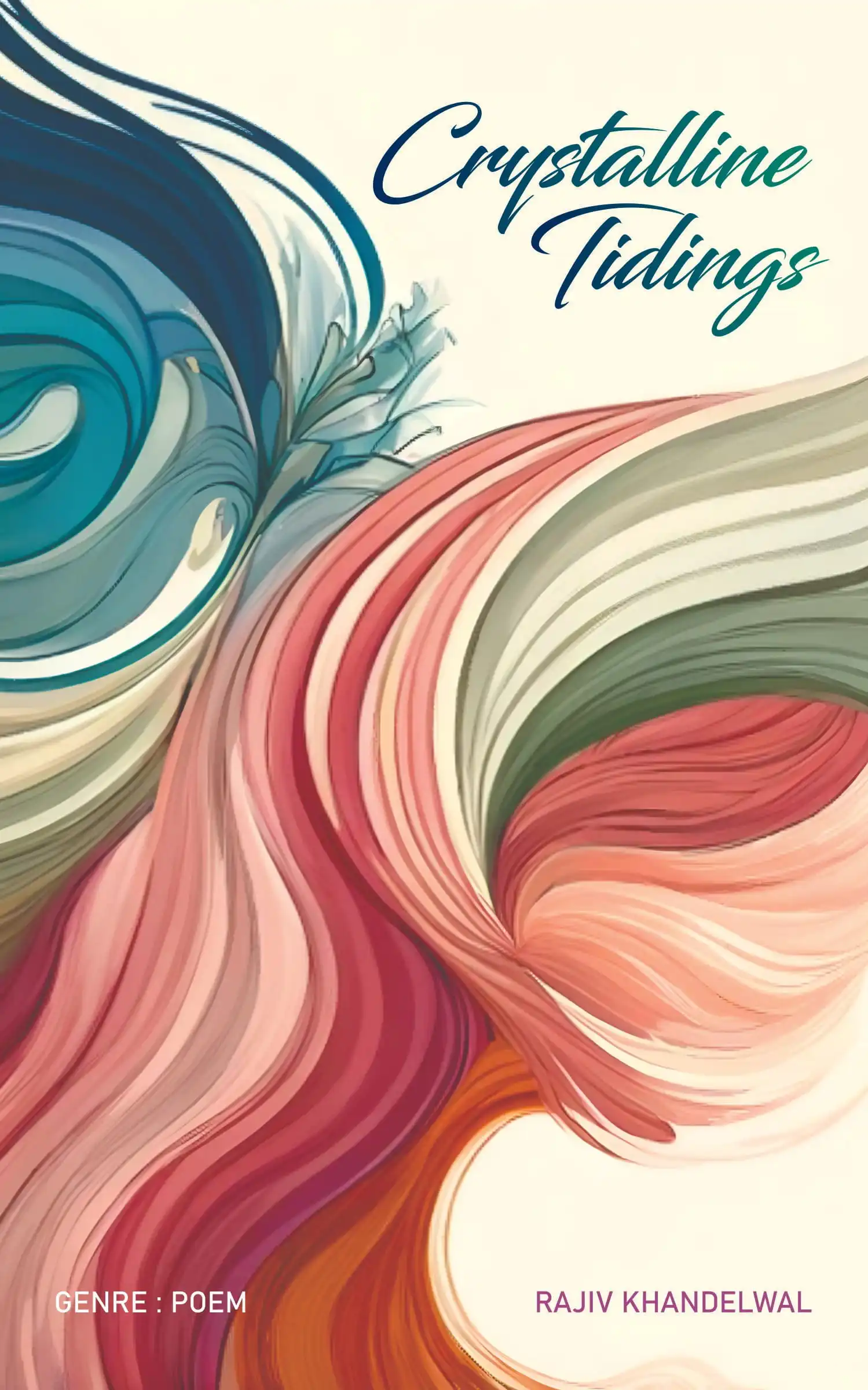
Crystalline Tidings
Rajiv Khandelwal’s Crystalline Tidings is a collection of 65 poems exploring memory, loss, relationships, and contemporary social issues. It is praised for its emotional depth, refined style, and striking language.
About the Book
Crystalline Tidings is Rajiv Khandelwal’s seventh collection and his most recent, gathering sixty-five poems written across his most mature period as a poet. The book moves between memory and the present moment, returning often to objects and rooms that hold the past, as in ‘The Tea Mug’, where a single chipped cup carries the residue of a whole relationship. Alongside these intimate poems sit others that look outward at the wider world, taking up subjects such as surrogate motherhood, radicalisation, climate change and the isolation that follows a pandemic.
Age, grief and the slow work of loss run through the book as recurring concerns, met directly in poems like ‘Creeping Darkness’ and ‘Death of a Parent’. The foreword writer Gurdev Chauhan observes that this collection finds Khandelwal engaging more seriously with the daily vicissitudes of life, and that his satire on contemporary ills is matched throughout by what Chauhan calls his immaculate style and surprising language.
PRAISE AND CRITICAL ACCLAIM
“Crystalline Tidings is not a collection but a prism, refracting the mundane into spectra that reveal what visibility costs. Khandelwal achieves what Edward Said demanded of the postcolonial intellectual: not merely critique from the margins, but testimony from within the fissures of power, where the personal and political fuse under pressure. This is a poetics of attention in an age of distraction.”
Dr Parminder Singh | Assistant Professor of English, Dev Samaj College for Women, Chandigarh“Rajiv Khandelwal, as a poet of social consciousness, holds mirror to society through the poems of his latest collection entitled Crystalline Tidings. He has an observant eye for the people and their manners and lifestyles, pains and tears and so on to portray them with microscopic and kaleidoscopic details.”
Prof. Dr Rajamouly Katta | ‘A Distinctive Voice to Resonate with Contemporary Relevance’“Rajiv Khandelwal’s poems draw inspiration from mundane everyday life based on close observation of characters around him. The poems are not only varied in themes but rich in their depth and philosophy.”
Bharati Nayak | Bilingual Poet, Translator and Editor, Bhubaneswar, India“Crystalline Tidings is a beautiful collection of fascinating poems, very interesting and profound. These gems of the poems will certainly add to the richness of the poetic experience of the discerning reader.”
O. P. Arora | ‘An Anguished Appraisal of the Social Order’“If poetry is the deed of paying a microscopic concentration and consideration to mundane matters and substances, lifting these to become the extraordinary ones, Rajiv Khandelwal’s poetry is certainly an exceptionally created niche, contributing towards Indian Poetry in English.”
Sushminderjeet Kaur | GGN Khalsa College, Ludhiana“Crystalline Tidings is like a torch to lead us all along the track of sensitive poetry, or the poetry that aims at seeking the meaning of life with stresses on socio-cultural dynamics and existential dilemmas of modern times.”
Dr Biswanath Kundu | Kolkata“There is plenty of sap in the tree of Rajiv’s poetry and pleasant juice to refresh you.”
Aju Mukhopadhyay | Poet, Author and CriticCrystalline Tidings: A Postcolonial Phenomenology of Loss, Love, and Late Modernity
A review-essay on Crystalline Tidings by Dr. Parminder Singh.
Abstract
This review-essay positions Crystalline Tidings (2025) as a pivotal intervention in contemporary Indian English poetry, deploying a tripartite critical framework — postcolonial hybridity, phenomenological embodiment, and late-modern satire — to interrogate Khandelwal’s 65-poem anthology. Through close readings of key texts (‘The Tea Mug’, ‘Baby Factories’, ‘Reality Construct-1 & 2’, ‘Creeping Darkness’, ‘Shades of You’, ‘Turned Away, Turned Within’, ‘A Journey Unfolding’, ‘Catch-22’, ‘In God We Trust’, ‘Do Lawyers Have Daughters’, ‘A Woman’s Tale of Sorrow’, ‘Poetry of Lamentation’, and ‘Vested Interests’), the study maps how the poet negotiates personal grief, bodily decay, socio-political critique, and cultural memory within a globalised yet deeply localised idiom. The analysis concludes that Crystalline Tidings transcends regionalism to articulate a universal poetics of fragility, positioning Khandelwal as a late-modern successor to Agha Shahid Ali, Arundhathi Subramaniam, and other luminaries in Indian English poetry, while inviting readers to inhabit its crystalline structures as sites of ethical and existential reflection.
Keywords:
Indian English poetry, postcolonial hybridity, phenomenology, late-modern satire, embodiment, fragility, cultural memory, ethical inquiry
I. Introduction: The Prism of the Ordinary
Rajiv Khandelwal’s Crystalline Tidings arrives not with fanfare but with the quiet precision of a jeweller setting a final facet. Published in 2025 by Ukiyoto, this seventh collection, following Conch Shells and Cowries (1998) through to Khandelwal’s Poetic Process (2024), comprises 65 poems, many pre-published in journals spanning India (Poetcrit, Contemporary Vibes) to international platforms. The volume is framed by a dedication to familial memory — “To my father’s memory, to my mother in her ninetieth year whose strength inspires, and to all those who find light in loss” — and a foreword by Gurdev Chauhan. Yet the true architecture lies within: a crystalline lattice of love, loss, ageing, and moral reckoning that invites readers to peer through its multifaceted surfaces.
This review-essay adopts a threefold critical lens: postcolonial hybridity (Bhabha, 1994; Ashcroft et al., 2002) to trace linguistic and cultural fusion; phenomenological embodiment (Merleau-Ponty, 1962; Heidegger, 1962) to unpack the lived body in decay; and late-modern satire (Hutcheon, 1994; Baudrillard, 1994) to dissect socio-political critique.
Through close textual analysis, the study argues that Crystalline Tidings forges a poetics of fragility-as-resistance, transforming the mundane into a site of existential and ethical inquiry. The anthology’s structure, with poems clustered thematically around loss, body, and society, mirrors a mandala-like design, where each facet reflects the whole, encouraging readers to engage in contemplative reading. Khandelwal’s minimalist style, most poems under 30 lines, amplifies this effect, turning brevity into an ethical stance against excess in an era of algorithmic noise.
II. Postcolonial Hybridity: English as Bhasha, Not Empire
Khandelwal writes in an English that is neither colonial residue nor globalised monoculture but a third-space vernacular (Bhabha, 1994). The idiom is fluent yet unapologetically Indian, as seen in phrases like “hot and piping Chole Bhature” from ‘Turned Away, Turned Within’, “Bhabhoot on father’s face” and “Antahkarana awakened” from ‘A Journey Unfolding’. These are not ornamental intrusions but structural load-bearers. In ‘Turned Away, Turned Within’, the Punjabi “Chole Bhature” evokes a middle-income ritual of comfort denied to the beggar-woman:
I was in queue for hot and piping Chole Bhature I turned a deaf ear to her pleas. “Bhabhoot” (sacred ash) in ‘A Journey Unfolding’ is ritual technology, a nonagenarian’s final act of faith: With Parkinsonian hands, smeared Bhabhoot on father’s face. “Antahkarana” — the inner organ of conscience in Vedantic philosophy — elevates a temple scene into ethical phenomenology: My Antahkarana awakened A divine whisper asked When I would be a source of joy to others.
This hybridity aligns with Ashcroft et al.’s (2002) concept of postcolonial transformation: English is abrogated from imperial norms and appropriated for local expression. In ‘Shades of You’, the speaker encounters a poetess in a sharara suit at a book fair, then a film actress in stone-washed jeans, both refracted through the prism of a 40-year marriage:
Dressed in a light blue embroidered Sharara suit The same color that so enhances your appearance wearing stone-washed skin-fit jeans The type you wore When we were holidaying in the Caribbean.
The poem enacts what Appadurai (1996) terms transnation: “In every woman I happen to view / Shades of you / You alone!” The beloved is not lost but diffracted across cultures, a postcolonial palimpsest where Caribbean holidays and Agra evenings coexist.
Comparatively, this hybridity resonates with Caribbean poets like Derek Walcott, whose Omeros (1990) fuses Homeric epic with Creole idioms to forge a hybrid postcolonial sensibility. Similarly, Khandelwal’s ‘Turned Away, Turned Within’ transforms a simple street encounter into a meditation on social exclusion, where the beggar’s plea disrupts the speaker’s complacency:
I retreated Scorched by the fire of Gyan Agni And stirrings of self-inquiry.
III. Phenomenological Embodiment: The Body as Text
The collection’s middle suite (‘Creeping Darkness’, ‘Reality Construct-1 & 2’, ‘Catch-22’) is a sustained meditation on bodily betrayal. Khandelwal deploys Merleau-Ponty’s (1962) corps vécu — the lived body — to render disease not as metaphor but as co-author of consciousness.
In ‘Creeping Darkness’, chronic illnesses are anthropomorphised: I now live with diabetes Cardiovascular blockages Hypertension Who stay as permanent house guests in my frame.
The lineation enacts invasion: each condition occupies its own stanzaic room. The speaker learns to “make friends with the disorder,” a phenomenological reorientation where pain becomes Lebenswelt (Husserl, 1970):
Sometimes When in a melancholic mood I wish the creeping darkness advances faster.
This echoes Scarry’s (1985) The Body in Pain but with a crucial difference: Khandelwal’s body is not silenced — it negotiates.
‘Reality Construct-1 & 2’ push this further into delirium as method. In ‘Reality Construct-1’, post-hip surgery, the 90-year-old father insists the operation never happened: “How his son was billed a heft amount / Without even the operation happening.” The poem’s fragmented syntax mirrors cognitive slippage, a formal enactment of Heidegger’s Geworfenheit (thrownness) (Heidegger, 1962). The ICU in ‘Reality Construct-2’ becomes a liminal zone where time dilates and family visits are hallucinatory:
Drifting in and out Of surgical sedation I lay alone in the Intensive Care Unit In ‘A Woman’s Tale of Sorrow’, female embodiment is portrayed through the lens of reproductive and pandemic loss. The poem’s speaker embodies a fractured perceptual field: The feverish, fatigued Middle aged woman Her spirit worn and weary Bore the weight of sorrow upon her shoulders Each step heavy with the weight of loss.
The narrative escalates to bureaucratic abandonment: “Her tears, suppressed torrential downpour / Left her heart raw and bleeding / After the labyrinth of bureaucracy and social support / Cold shouldered her in a maze of indifference.” This adds a gendered layer to the collection’s phenomenology, revealing how bodily fragility is inflected by patriarchal structures: “For she was under family and social boycott / As she had married inter-caste.” By juxtaposing this with male-centric poems like ‘Creeping Darkness’, Khandelwal subtly critiques the universality of embodiment, inviting readers to consider intersectional vulnerabilities.
IV. Late-Modern Satire: The State as Farce
The collection’s political movement (‘Baby Factories’, ‘In God We Trust’, ‘Do Lawyers Have Daughters’) wields satire as diagnostic tool. Linda Hutcheon’s (1994) framework of irony as discursive provides the critical lens: Khandelwal’s irony exposes the gap between official rhetoric and lived reality.
‘Baby Factories’ is the collection’s political masterpiece. Responding to a 2016 headline on surrogacy bans, the poem adopts the voice of bureaucratic doublespeak:
We believe strongly You do not have the legitimacy To your uterus Do what you wish With it. No poor Illiterate Women Who purportedly can’t think clearly Ethically Or morally Will hereafter be allowed to prosper
The poem’s structure, short staccato lines, mimics legalese. The ban protects not women but the spectacle of protection (Baudrillard, 1994).
‘In God We Trust’ escalates this into absurdist prophecy:
Why allow ISIS To recruit our younger generation Let’s ourselves find students… Train them: In the art of pelting stones.
The satire is not moral outrage but ontological diagnosis: in late modernity, terror is produced, not prevented (Žižek, 2008). ‘Do Lawyers Have Daughters’ satirises judicial hypocrisy through a courtroom drama involving child marriage:
Suddenly, I was seized by severe anxiety My breathing and heart rate Stepped up the gas Unscripted I was magically transported To the traumatic tale of ‘Nirbhaya’.
The ironic refrain “Do lawyers have daughters” echoes Žižek’s notion of ideological fantasy, where legal systems perpetuate the very injustices they purport to eradicate. Comparatively, this satirical vein resonates with Arundhati Roy’s essays in The Cost of Living (1999), where state policies are lampooned as farcical performances.
‘Vested Interests’ extends the satirical gaze to corporate and military greed:
Irresponsible Irrational Nuclear weapons Loaded with annihilation capability With coercive means Harbor the sole objective Of making Ethics of Science Dignity Spirituality Respect for lives Commit suicide.
V. Formal Architecture: Compression as Ethics
Khandelwal’s poetics are minimalist yet maximalist. Most poems are under 30 lines; white space is ethical. In ‘The Tea Mug’, the cracked rim is not described but enacted:
Till the cracks Started Appearing.
The line breaks fracture the stanza, mirroring the object. This is Cleanth Brooks’ (1947) paradox of form: brevity contains multitudes
The influence of Indian oral traditions is subtle. The ghazal’s radeef echoes in repeated motifs (‘shades’, ‘creeping’), while the doha’s moral pivot appears in ‘Turned Away, Turned Within’: “When I would be a source of joy to others.” Yet Khandelwal never forces form. His is a post-ghazal lyricism — free verse that remembers its roots.
In ‘Poetry of Lamentation’, elegiac refrains build a sonic lattice:
But why can’t my husband see What you all see Cause now On seeing me His face has stopped coming alive with a smile.
This formal choice ethicises compression: by distilling experience into sparse lines, Khandelwal resists the verbosity of colonial literary traditions, aligning with subaltern aesthetics in poets like Kabir.
VI. Limitations and Horizons
The collection is not flawless. The ageing-male gaze dominates: female subjectivity is often mediated (‘A Woman’s Tale of Sorrow’, ‘Poetry of Lamentation’). The satirical suite occasionally tips into polemic (‘Vested Interests’). Yet these are productive flaws — they invite dialogue.
The anthology’s urban-centric focus marginalises rural voices, a gap that could be addressed in future works by incorporating more diverse regional idioms. Yet horizons are vast: Crystalline Tidings opens avenues for ecocritical readings, as poems like ‘Creeping Darkness’ metaphorise illness as environmental intrusion. It also paves the way for digital humanities analyses, tracing intertextual networks with global poetry platforms. The collection’s engagement with pandemics and social isolation suggests potential for post-COVID literary studies, where fragility becomes a lens for global crises.
VII. Conclusion: A Poetics of Fragility
Crystalline Tidings is not a collection but a prism, refracting the mundane (tea mugs, ICU bills, surrogacy bans) into spectra that reveal what visibility costs. Khandelwal achieves what Edward Said demanded of the postcolonial intellectual: not merely critique from the margins, but testimony from within the fissures of power, where the personal and political fuse under pressure.
This is a poetics of attention in an age of distraction. Where algorithms flatten experience into scrollable affect, Khandelwal’s verse insists on duration, the slow work of mourning, the durational ethics of care. His crystalline form is paradoxical: fragile enough to catch light, unyielding enough to cut.
By centring feminist critique and comparative frameworks, we see how Crystalline Tidings moves beyond elegy. It maps resilience not as recovery but as permeability, the ability to hold grief and tenderness simultaneously. In this, Khandelwal joins Agha Shahid Ali’s diasporic mourning, Arundhathi Subramaniam’s embodied spirituality, and global contemporaries like Ocean Vuong and Warsan Shire, who write survival as intimate architecture.
The crystal does not reflect reality; it refracts it. And what emerges, bent, split, iridescent, is not loss diminished but loss transformed into a medium for seeing. This is poetry’s enduring claim: to crystallise the unbearable into something we can hold, if only for the length of a line. Crystalline Tidings is not merely read. It is inhabited, a testament that in fragmentation, we find new forms of coherence.
References
- Appadurai, A. (1996). Modernity at Large: Cultural Dimensions of Globalization. University of Minnesota Press.
- Ashcroft, B., Griffiths, G., & Tiffin, H. (2002). The Empire Writes Back: Theory and Practice in Post-Colonial Literatures (2nd ed.). Routledge.
- Aziz, P. S. (2025). Echoes of Us: Selected Ghazals and Sonnets. BookLeaf Publishers.
- Baudrillard, J. (1994). Simulacra and Simulation. University of Michigan Press.
- Bhabha, H. K. (1994). The Location of Culture. Routledge.
- Brooks, C. (1947). The Well Wrought Urn: Studies in the Structure of Poetry. Harcourt Brace.
- Csordas, T. J. (1994). The Sacred Self: A Cultural Phenomenology of Charismatic Healing. University of California Press.
- Heidegger, M. (1962). Being and Time (J. Macquarrie & E. Robinson, Trans.). Blackwell.
- Husserl, E. (1970). The Crisis of European Sciences and Transcendental Phenomenology. Northwestern University Press.
- Hutcheon, L. (1994). Irony’s Edge: The Theory and Politics of Irony. Routledge.
- Merleau-Ponty, M. (1962). Phenomenology of Perception (C. Smith, Trans.). Routledge.
- Roy, A. (1999). The Cost of Living. Modern Library.
- Said, E. W. (1993). Culture and Imperialism. Knopf.
- Scarry, E. (1985). The Body in Pain: The Making and Unmaking of the World. Oxford University Press.
- Walcott, D. (1990). Omeros. Farrar, Straus and Giroux.
- Young, I. M. (2005). On Female Body Experience: “Throwing Like a Girl” and Other Essays. Oxford University Press.
- ZiZek, S. (2008). Violence: Six Sideways Reflections. Picador.
An Introspective Look into Rajiv Khandelwal’s Crystalline Tidings
A critical review by Biswanath Kundu.
Abstract
Crystalline Tidings, a collection of sixty-five poems penned by Rajiv Khandelwal, one of the globally known Indo-Anglian poets of honour and accomplishment of the contemporary period, published by Ukiyoto Publishing, India, is like a torch to lead us all along the track of sensitive poetry, or the poetry that aims at seeking the meaning of life with stresses on socio-cultural dynamics and existential dilemmas of modern times. He has excelled in the task of regenerating sense and conscience of what is beautiful as well as dutiful about the world in all these poems that are marked with symbols, similes, and mellifluous metaphors.
Keywords:
Childhood memories, love, religion, humanism, Covid time, social crimes, death and emptiness
There are both short and long poems with deep layers of meaning that can only be guessed from reading between the lines. The poems included in the present anthology are based on various themes such as childhood memories, human concern, ethics, morality, night syndrome, love, romance, nature, introspection, curses of war, ageing, faith, Covid time, political concern, elegy, mysticism, realism, and spiritualism, all of which affect the flow of life everywhere in the world. Most of the poems are marked with metaphors and similes of evocative meaning.
The collection opens with the poem ‘The Tea Mug’, which revolves around the sweet childhood memories of enjoying tea in a beloved mug until it cracked. Exuberant ecstasy in sipping from the mug has been caught finely and nostalgically:
The yellow rim Reminds Of freshness Of the sensuous lips That once used this mug. ‘Deschooling’ is another beautiful poem depicting stress-free childhood. The golden period of life, found in tension-free childish sports enjoyed like free birds, may be perused from the following: If we simply re-learn to laugh like a drain For no visible reasons And release ourselves From society’s unseen shackles without strain And re-gain the freedom to do whatever we desire Without the burden of reason that adults acquire.
The collection includes a number of love poems. The romantic thoughts of the poet are best expressed in ‘Shades of You’, ‘Archive’, ‘That Evening’, and others:
She was wearing Pink matte lipstick The one that you know I love so much seeing you wear it In every woman I happen to view Shades of you You alone! … darling, leave without worrying For I have sealed all doors Flared out all the host demons Swayed by Eros.
Thoughts of death, disease, and decay developed as a follow-up of ageing are scattered across poems like ‘Whispers of Departure’, ‘The Grey Silhouette’, ‘Solace’, ‘The Wait’, ‘A Journey Unfolding’, ‘Reality Construct-1’, and ‘Reality Construct-2’. In ‘Whispers of Departure’, witnessing the embrace of death as swiftly as the fleeting existence of a baby mouse, and the impact of this pain of bereavement, have been portrayed finely:
The pervading Vacuum Brings to naught Find solace in the poetry of sorrow Where whispers of departure linger.
In ‘The Wait’, the helpless waiting for certain death, followed by a series of incurable ailments developed in old age, has been penned finely:
None of the present clan Could muster the strength To assist Remove the life-support-system And allow the candle to snuff out Agonizingly Minutes passed Into hours and then into days All Kept waiting.
‘The Grey Silhouette’ deals with the complexities of old age. Problems such as decline in blood flow to the brain and the onset of diabetes, as well as memories of sweet former days, have been delineated finely:
Grey is fighting for survival Silver seems to be timing its arrival. ‘Reality Construct-1’ and ‘Reality Construct-2’ not only highlight old age problems but also bring to light the great lapses presently found in health care systems. Scams in medical billing for indoor patients have been highlighted in ‘Reality Construct-1’: He still could not figure out How his son was billed a heft amount Without even the operation happening … He resolutely adheres The current times, loaded with scams Are now, not what they used to be in his days.
In ‘Reality Construct-2’, great lapses of vigilance and attention to patients admitted in ICUs without caring family are shown prominently:
I am confused and disoriented No one can enter ICU With food In the ICU I have lived What I have gone through.
Poems like ‘Grief’s Encounter with the Beyond’ and ‘Turned Away, Turned Within’ are reflective of thoughts unbounded by material interest, drenched in spiritualism. The conversation between the living and the deceased is penned finely in ‘Grief’s Encounter with the Beyond’:
In eternal repose she lay A world beyond my mortal grasp The same pants for three days now Shave, change your clothes, my love Carry on with life, I am beside you.
‘Turned Away, Turned Within’ is another beautiful poem dealing with sublime spirituality. The denying of helping hands to the needy is an easy exercise, but finding oneself in need before God is a natural development:
A divine whisper asked When I would be a source of joy to others When would I embrace empathy?
The burning social problems and crimes of mob lynching and rape do not go unnoticed by the poet. In ‘In a Free Country’ the hapless and helpless condition of the poor Indians at the hands of moneylenders has been touchingly described:
He thought of his unlettered wife Pregnant with his second child And his sweet ten year old daughter His old palsied father All being roughed up by the loan shark The man lay dying Not even realizing That in all innocence He was At the wrong place At the wrong time In a free country.
‘Do Lawyers Have Daughters?’ draws a vivid picture of crimes that kill the peace of mind of people and questions the conscience of lawyers who advocate for perpetrators:
Lawyers still resort to tricks of their trades To delay legal justice.
Quite a few poems address the memories of the panicky quarantine period of Covid-19. The poems ‘Death of a Parent’, ‘Abandonment’, ‘A Woman’s Tale of Sorrow’, and ‘The Isolation of Friendship’ bespeak the same. In ‘Death of a Parent’, the pains of survival during Covid time, which restricted movement even on hearing of the death of a parent, are showcased finely:
Covid restricts Intercontinental movements Due quarantine rules And I lived the loss Felt by a paralytic Who literally has his body. The abandonment of morals and values at the onset of corona has been penned brightly in ‘Abandonment’: As the world knew About the catastrophic powers of Corona So they abandoned Morals and values Like one leaves cattle Due to scarcity.
‘A Woman’s Tale of Sorrow’ is a heart-touching story of the utter helplessness of someone who lost her husband during the corona period. The reality of social ostracism during Covid time, and the grief of loss compounded by a family boycott over an inter-caste marriage, are nicely penned:
Through the tears and torment, She knew not what to do But like Savitri She had her Satyavan-husband’s head on her lap In a lover’s doleful embrace.
The theme of war and peace has been nicely dealt with in ‘Vested Interests’. The vested interests of profiteering from the sale of deadly arms, at the gross disrespect of humanity and resulting in loss of lives, are pinpointed finely:
Vested interests Plan a planetary cemetery More deaths More retaliatory weapons needed Who cares For human misery.
The blend of humour, ethics, and corruption is inducted artistically in ‘Cultural Diversities’. Corruption at high levels, or justice on auction, is penned finely:
People in some countries Can yet be stunned When one of their politicians Executes a fraud And donates A passel of money To find Justice was on bid Charges could be diluted And dropped.
The poet’s concern for the surrogate mother is seen in ‘Baby Factories’. The theme of the exploitation of poor women who rent their wombs for commercial considerations is portrayed vividly:
… you shouldn’t die on the operating table Or to unregulated medical methodology When you rent your womb for commercial considerations And improve loved one’s living condition At the altar of surrogacy.
Marital relations are weighed fantastically in ‘Faith’. Comparisons between arranged marriage and love marriage are nicely drawn with similes, and the key to success in marriage is pointed out:
Success in marriage Lies somewhere In the fine balancing Of the unread book/s.
Poets are generally good philosophers too. Khandelwal is no exception. The poems ‘The Burdened Tapestry of Memories’ and ‘Bequest’ are replete with philosophical thought. The call for withdrawing the self from carrying unnecessary loads of memory and instead enjoying the present consciousness is reflective of his philosophic entity:
Who do I hold accountable For schlepping the weight Of the tapestry of memories Real, imaginary or false …
His mystic self is traceable in the wandering of his mind as it explores the truth of life for a pleasant stay in the present rather than getting disturbed by the past’s embrace and the future’s worries:
Live in the present like a sunflower following the sun Do not let the past’s embrace hold you back Or allow the future’s anxious whispers to haunt.
As a master craftsman dealing with myriad themes evident from travels, travails, and troubles in life, Rajiv Khandelwal has not only brought haloes and glows to modern Indo-Anglian poetry but has excelled in the task of regenerating sense and conscience of what is beautiful as well as dutiful about the world, as visualised from the poems marked with symbols, similes, and mellifluous metaphors. The majority of the poems included in this collection belong to the Indian soil in particular and carry a global perspective with regard to themes that transcend time and space. The entities of the realist, the humanist, the spiritualist, and the wordsmith are combined in Rajiv Khandelwal, who has carved a niche in world literature with his power of words and logical deduction on Indian thought processes. Readers will again be gifted with a microcosm of poetry like that found in A Monument to Pigeons, Dwelling with Denial, and A Time to Forget.
Works Cited
Khandelwal, Rajiv. Crystalline Tidings. Ukiyoto Publishing, India, 2025.