Dwelling with Denial
Blending intimate emotions with wider social concerns, these poems speak with honesty and grace. Their vivid imagery and thoughtful voice leave a lasting impression.
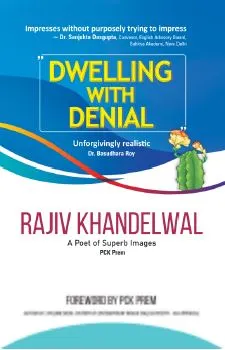
About the Book
Dwelling with Denial gathers seventy-five poems that move between the intimate and the public. The opening poem, ‘Petition’, sets the tone with its address to a wife from a man newly told of his cancer, framed as an appeal to God that has gone unanswered. From there the collection turns outward to look at strangers and back again to family, taking in visits to relatives, a grandfather’s conversation with preschoolers, and the small frictions of married life. Several poems take up subjects rarely treated this way in Indian English poetry, among them a comic account of a puja interrupted not by passion but by an itch.
Khandelwal also writes about the act of writing itself, returning more than once to the difficulty and the reward of waiting for a poem to arrive on its own terms. Running beneath this variety is a steady attention to denial in its many shapes, from the denial faced by the poor and the dispossessed to the smaller denials within a household. His foreword writer, P C K Prem, calls him a poet of superb images, and his preface writer, Sanjukta Dasgupta, observes that he impresses without purposely trying to impress, a quality that holds across the full range of the book.
PRAISE AND CRITICAL ACCLAIM
“Rajiv Khandelwal’s fifth volume of poems, Dwelling with Denial very tenderly captures the rhythm of the uncertain times that we inhabit. Contemporary, well-crafted, ironic, pensive, and unforgivingly realistic, Khandelwal’s poems in this collection not only constitute a litany of our unvoiced dreads but also a glowing tribute to our undying human urge to assert our rights to love and heal in a broken world.”
Dr Basudhara Roy | Assistant Professor, Department of English, Karim City College, Jamshedpur“In Dwelling with Denial, the fluidity of sounds in Rajiv’s use of language is joined to the fluidity of his thoughts. This poet has a rare combination of talented metaphors and musicality of words. When he combines all his skills, including concrete poetry, alliterations, musicality, fluidity of thought, and social criticism, we are sure we are in front of one of the best Indian poets in English.”
Maria Cristina Azcona | Buenos Aires, Argentina; WWPO Worldwide Peace Organization President and founder; Ars Artium Poetry Editor“Dwelling with Denial is an endearing resource from Rajiv Khandelwal, a recognized modern Indian poet. An engineer by profession, Khandelwal engineers his poems with precision, turning each into a marvel of expression. His identity emerges as multidimensional — the wit is akin to Ezekiel, the observations on family ties remind one of A. K. Ramanujan, and the delineation of sensuality shows a marked influence of Kamala Das.”
Dr Neelanjana Pathak | Head, Department of English, St. Aloysius’ Autonomous College, Jabalpur“A manifesto of individualism, Dwelling with Denial transports the reader straight away into the far-far away world of the inner self.”
Dr Ashish Mohan Srivastava | Freelance literary critic and scholar“Rajiv Khandelwal is one such distinguished, contemporary Indian English poet whose poems are highly appealing because he represents the modern world in all its complexities.”
Dr M. B. Gaijan | Head, Department of English, Samaldas Arts College, Bhavnagar UniversityReviewed by
- Dr Kailash Ahluwalia — ‘Submission and Persuasion in Khandelwal’s Dwelling With Denial’.
- Maria Cristina Azcona — ‘Thumbnail Images’.
- Dr K. Balachandran — ‘A Literary Communiqué’ — Click here to read this review.
- Dr. Julia Devardhi | Principal, Nalanda Educational Institutions, Hyderabad | The Criterion: An International Journal in English, Vol. 12, Issue I, February 2021, ISSN 0976-8165 Article available at: https://www.the-criterion.com/V12/n1/Julia.pdf
- Prof. R. K. Bhushan Sabharwal — ‘Sequential Flow of Life’
- Dr Rima Chakraborty — ‘In Search of a Romantic Gateway in Select Poems of Rajiv Khandelwal’.
- Dr D. C. Chambial — ‘Exploring Khandelwal’s Poem in the Poet’s Palm’
- Shobha Diwakar — ‘Editorial’
- Dr Jayshree Goswami — ‘Perspective Observations on Khandelwal’s Poetic Chronicles’
- Ramandeep Kaur and Kamaldeep Kaur — ‘Filtered Percolation of Emotions’
- Dr Sangeeta Mahesh — ‘Structured Snippets’
- Pravat Kumar Padhy — ‘A Social Logbook’.
- Dr Manoj K. Pathak — ‘A Collection of Undeniable Poems’.
- Dr Neelanjana Pathak — Dr Neelanjana Pathak — 'Verity and Versatility of Verse: Deliberations on Khandelwal's Dwelling With Denial' | JLCMS Special Issue on Rajiv Khandelwal, Vol. XV, Issue 27, 2022, pp. 161–170; also Poetcrit, Vol. 35, No. 1, 2022, pp. 108–113 — Click here to read this review
- Anshulika Paul — ‘Sentimental Musings about Mundane Affairs’.
- Dr Suresh Chandra Pande — ‘An Objective Thematic Explication’.
- Dr Vijay Kumar Roy — ‘Snapshots of Society, Religion and Politics’.
A Literary Communique
A perceptive critical review of Dwelling with Denial, highlighting its literary richness and thematic depth.
Dwelling with Denial blossoms forth Khandelwal’s aesthetic, didactic, imaginative, prophetic, philosophical, and romantic petals.
The opening poem ‘Petition’ is an earnest entreaty to God, written after lighting a thousand diyas to commute a death sentence from cancer gnawing away at the speaker’s vitals. The petition is rejected. The speaker then petitions his wife:
Come soon Wipe away my tears Bring faith and joy Come before
The poem ‘Puja’ reveals hopelessness and loss of business. A puja is undertaken to provide:
to provide Overall prosperity and happiness Ensure health and longevity Bring good luck and success And cleanse myself of sins.
But the puja does not fetch the desired results. Just as Menaka diverted Vishwamitra with her seductive charm, a back-side itch diverts the narrator’s attention and “broke the dream / Of attaining desired results / Through this puja” (p. 3), which is at once humorous and sad.
‘To the Pilots Who Visited Balakot’ is about the vultures who crossed the garden to feast upon the dead soldiers across the Line of Control in the Pulwama attack. The poem ‘Tension’ details the tensions that prevail on both sides of the Line of Control:
Strain on politicians For both sides clamour for blood As seventy years of enmity Goes with us and governs us.
‘Thank You’ is a thanksgiving note to the street dog that guarded the house and imbibed confidence in the narrator.
The poet gives considerable importance to family relationships, writing of his mother, daughter, granddaughter, wife, and son-in-law. The poem ‘Wandering Thoughts’ has autobiographical elements, as he fondly writes about his daughter:
you are my pride and joy Your nature shines A daughter beyond compare You are stellar and rare.
The tone shifts from daughter to wife, as the poet’s thoughts vaporise and he confesses:
I have never loved Anyone As much as I love your mother
‘Critical Comments’ is a poem about the narrator’s granddaughter, who tells him: “Nana — you do not know how to tell a story …. Nani is better” (p. 12). In ‘Mother in Our Joint Family’, the narrator is flabbergasted to see his elderly mother still vigorous: “How your battery life is still running at full charge” (p. 13).
‘Happy Birthday Son-in-Law’ is a poem in which the poet lovingly writes
It was power of love all the way That made you a part of our family We have reasons to be contented and feel happy you are everything we could hope for in a son-in-law Who has no big or nano small flaw And that he’s just plain great
In ‘A Tribute to the Maternal Uncle’, the poet mourns the sudden and unexpected death of his uncle and writes, in grief:
With his left memories Bereaved I Carry on with the business of living
In the title poem ‘Dwelling with Denial’, Khandelwal writes: “We / The doubly disadvantaged / Be destined to dwell with denial” (p. 24). Unusual, unhappy, and unexpected happenings, submissive silence, economic echoes, outstanding loans, sheltering in sheds, and living a life worse than animals are some of the issues that compel one to dwell with denial.
Pleading in a Dubai Club’ word-paints a night club where “all subconsciously, clothed for sexual signaling” (p. 26). ‘Dear Mate’ is a personal poem in which the poet delineates the characteristic features of his wife:
You have charm and grace No wrinkles still on your face You have poise and elegance Comes from so much experience you still have a healthy glow, a spring in your step most people would like to follow your footsteps
In ‘Union’, the narrator and his beloved meet in a coffee house and are absorbed in their courtship: “The pandemonium around / Felt sound-free” (p. 34). Gently the narrator thrusts his hand forward and leaves it idle until his companion advances to touch it. “No one spoke / Nothing needed to be said… The hot coffee untasted” (p. 35).
‘Call You Later’ is a poem about a secret love affair. When the narrator is with his family, a call arrives and its source is identified on screen. Every ring brings fresh images before his love-torn eyes. “The fourth ring / Satisfying to the mind as water to thirsty lips / Came like the bride carrying thoughts of budding love / Flaunting her pre-wedding henna adorned palms” (p. 39). However, in the presence of his family the narrator says: “Am having dinner, can I call you back?” (p. 40).
‘A Dilemma’ speaks about the predicament of a woman who receives a strategist’s gratifying love poems. “Perchance he loved her / More than her husband did now” (p. 30). The poems “made her feel amazingly beautiful” (p. 30), leaving her “peppered with the dilemma / of coveting both her husband / and the poet” (p. 31).
The poet satirises society where people frequent temples for mixed motives in ‘Guilty’. They visit to mark festivals, celebrate marriages, communicate births, mourn deaths, seek emotional pleasure, request economic progression, and solicit political success. Yet “a thirsty child / On basis of caste / Is not allowed to drink water” (pp. 37–38).
‘Job Trackers’ is a poem on job seekers. The final four lines form the crux and are startling in their realistic portrayal of the present political scenario:
So, for placements, come to ‘Job Trackers’ We will train you As we have confirmed ongoing demand For would-be terrorists
‘The Suckables’ is a poem on the arrival of the mango season, yet it is sprawled with cleverly planted erotic imagery:
The full plump oval Sans spots or speckles Emanating a lovely sweet fragrance Attracts… … When I softly squeeze The softness gives slightly The alluring pinkness Looks highly suckable Mango season arrives
‘A Backward Glance’ is a poem about the narrator’s beloved’s refusal to have coffee with him, leaving him “again left / Without a ‘backward glance’” (p. 61). ‘An Unplanned Visit’ registers a visit of no avail: “Her impish smile / Conveys: You have a dirty mind” (p. 63). ‘Unfulfilled Hungers’ narrates the narrator’s “just waiting for you to arrive” (p. 69). Yet in ‘In Rain Forests’ she visits: “It was her first visit / After her death.” This poem reflects the narrator’s unrequited love and his running after a mirage.
‘Dreamy Expectations’ captures a grief shared by many. “Five feet away / My nephew / Chose to use WhatsApp / Rather than a chat / To compliment me / Talking has died” (p. 73). Talking in person has lost its lustre and social media has captured modern communication.
In ‘Fractured Reality’, the narrator’s beloved informs him: “You can have me as much as you want…. Not in a sexual manner.” His “anticipated orgasmic pleasure / Died a dowry death” (p. 78). Is this not dwelling with denial?
The anthology ends with the seventy-fifth poem, ‘The Poem Unborn’, which mirrors the present-day world:
Rape of minor by minors Rape of elderly by elderly A politician beating someone Economy going downhill Sponsored terrorism going uphill Some are demanding facilitation fee Some are facing corruption charge
One must applaud Khandelwal for his realistic and stirring portrayal of himself as narrator, of society, and of the country in a lucid style. He has the grit to bring forth more volumes of verse with poems that are demanding and decorating, enervating and energising, horrifying and harmonising, emotionally relieving and recuperating.
Verity and Versatility of Verse
Dr. Neelanjana Pathak offers a perceptive critical study of Dwelling with Denial, exploring Rajiv Khandelwal's poetic craftsmanship, thematic depth, philosophical vision, and the remarkable versatility of his verse.
A poem is an episode completed in an hour or two, but poetry is something more, it is why The how, the what, the flow from which a poem comes
Dwelling with Denial, with its arresting, alliterative title, is a new endearing resource for poetry lovers from Rajiv Khandelwal, a recognised modern Indian poet now prescribed in college syllabi. An engineer by profession, Khandelwal engineers his poems with precision, turning each into a marvel of expression. As a result, the reader is ushered into an inward onward journey within the recesses of the locked-up self.
The criticism of poetry has always been a wide-ranging, dynamic, yet challenging realm of study. To compress a critique of seventy-five very different poems into one vast appraisal seems a formidable task. This one volume knits together the various threads that comprise human life and emotions, connecting various dots of experience and fusing them into one larger picture that creates a lasting impact, leaving the reader in awe as they turn the last page.
As in life, joy and sorrow, optimism and pessimism, the imaginary and the real, the virtuous and the evil coexist; so also do they appear together under one title in this collection. Khandelwal’s images in most poems are primarily woven around contemporary Indian urban life. In this selection of seventy-five pithy verses, there is a feast for the senses as also food for deep contemplation. We enjoy the changing hues of the poet’s thoughts, at times grim, at others sublime or even prophetic:
Then the poem Can honestly claim To be owned and understood
In these vignettes from contemporary India, we encounter modernism (in ‘Pleading in a Dubai Club’), human values (in poems on relationships), shades of love (in ‘A Dilemma’), relationship (in ‘Wandering Thoughts’, ‘Mother in Our Joint Family’), sex, sensuality, and celebrations of the body (in ‘Try Missing Me’, ‘Etched in Memory’).
As the country comes to terms with new social, political, and economic realities, the poet’s keen observations help him present screenshots of these in lines suffused with realism:
We are trapped to do donkey-work With or without pay Khandelwal has come to terms with the stark social realities facing India and treats them with a humanistic stroke: And shockingly Outside temples sanctum sanctorum A temple-goer Who just gave a substantial sum In homage to the deity Refuses a tramp Paltry charity
Themes of social and cultural alienation fascinate the poet and recur here as in other volumes. This foregrounding of cultural and social realities of his time makes the poems contemporary, relevant, and very readable. His India is not an idealised version but a third-world nation, hypocritical, regressive, and increasingly corrupt, expressed in hard-hitting and flippant language:
Compassion Helplessly Stands frozen Like the bystander Viewing Stalker stabbing schoolteacher In broad daylight On the busy New Delhi Street
His keen observation of social realities and their witty documentation reminds one of the social satire of Addison. Most poems, typical of the postcolonial phase in Indian English poetry, show concretisation of the most abstract thoughts and emotions:
Sprouting nympholepsy Perished prematurely Like female foeticide And the anticipated orgasmic pleasure Died a dowry death
He displays wizardry with words in using concrete images, conceits, and indirect metaphors to express the inexpressible. Every poem, despite some themes overlapping, is unique with something new to offer. The heterogeneous range of subject matter, from an anniversary to human trafficking and sex workers, leaves the reader in awe of the wide sweep of the poet’s imagination.
Some poems open abruptly with very ironical expressions that trigger the reader’s curiosity:
Business had been going Through a rough patch So, we decided to do a puja
Despite there being a discernible start in most poems towards depiction of everyday grim truths, there are flashes of joy, hope, and an undercurrent of subtle humour. The source of the humour is often hyperbole:
For we haven’t spoken to each other in aeons There are also instances of self-deprecating humour: Nana — you do not know how to tell a story I am leaving Nani is better As always My efforts Fail
We find in these poems our buried fears as also our celebrated joys and an ultimate hope for a better future:
Today, we wish for nothing but a lifetime of smiles on your face Which no earthly setback should have the strength to replace The poet succeeds in establishing an immediate rapport with his unseen audience: The social media message Of less than 280 characters Arrived Punctuated with emoticons Praised me On winning the award
The series of relationship poems leads one to surmise that Khandelwal clearly cherishes human relationships with an inherent stress on integrity and commitment.
In some of the poems, women are glorified as an epitome of selfless love and supreme sacrifice: Things you do daily to make my life perfect, dear wife Make me feel the most important thing in your life
However, in a lighter vein, the poet mocks feminine idiosyncrasies (in ‘Wife’). The hapless girl’s body is captured in ‘Pain Deserving Understanding’. Her inexpressible anguish finds a voice through deft poetic devices, conceits, images, alliterations, and irony, all heightening the effect of her suffering line after line.
The most significant segment is the group of poems on poetry itself, covering the genesis, credo, process, functions, pleasures, and challenges of putting words together for composition. Documented first-hand by a poet backed by two decades and more of experience, poems like ‘Poem in the Poet’s Palm’, ‘Poem in the Being’, ‘Poem and the Poet’, and ‘A Successful Poet’ can provide fruitful content for a poetic manifesto. Many lines are reminiscent of Ezekiel’s much-acclaimed poem ‘Poet, Lover, Birdwatcher’:
Off and on, ever after much cajoling Words do not visit Surprisingly, even refuse to crawl
Lines like these, replete with wisdom that comes with experience, fill the pages of Dwelling with Denial and can be an exciting source for poets in the making.
The poet’s pain culminates in the title poem ‘Dwelling with Denial’. The poem reads like a commentary on the handed-down ‘burden of economic echoes’, mainly a result of debts incurred. It is filled with dark, suggestive images of “rats-infested small shacks and cattle in their shade.” Steeped in biting realism in language that is direct and poignant, the poet concludes that mortals living under financial burdens are worse off than animals who have the freedom to prey on their hunt to appease their hunger. This contentment is not destined for us humans, leading the poet to lament:
The doubly disadvantaged Be destined to dwell with denial
Beneath the sonorous words lies a grim realisation that stares at us mockingly.
Every poem appeals as an experiment in both craftsmanship and content, the ‘how’ and the ‘what’ that constitute the poem. The poet’s craft rests primarily on wit and subtle humour, especially in attacking follies and foibles satirically. The start is towards specificity and concretisation of poetic technique and content:
More lonely Than the heart shaped sugar cubes Stored in a container Kept at the back of the kitchen’s cabinet Beyond easy access In a highly diabetic bachelor’s studio apartment
The diction is unambiguous and creates melody in poetically rich lines, dense with meaning, turning the anthology into a potpourri of vibrant thoughts. The musical alliterations in so many poems contribute to the element of music and melody:
Solitude Sitting in Silence In a slightly sullen spirit
Words are used aptly. The language is primarily terse with carefully chosen diction but, where the theme so requires, it turns colloquial. Some fine poems are those composed in a conversational tone, as in ‘Puja’.
The poems in Dwelling with Denial do not always show a glowing sky without dark clouds. There are pages filled with thick clouds, thunder, lightning, hail, and dark rain:
Against the vulture That swept down my garden Every afternoon Since ‘Pulwama’ attack While it ought to be dive bombing With its flock To feast Across the LOC
Dwelling with Denial ends up as an engaging treasure trove of stimulating poetry that maps the poet’s journey through the ups and downs that constitute the very warp and woof of life. It leads the reader to reflect upon moral dilemmas encountered repeatedly by each of us, and in this sense the poems offer a miscellany of practical wisdom:
With his left memories Bereaved I Carry on the business of living
The reader discovers in these poems new perspectives on old themes that may propel them to alter their frameworks of thinking. The literary canons offer abundant scope for poems on angst, suffering, abandonment, disillusion, and despair, but to include them all under one cover and complement them with equally meaningful poems on hope, love, and fulfilment through relationships is a poetic feat that is laudable.
Khandelwal’s identity emerges as multidimensional. The wit is akin to that of Ezekiel; the observations on family ties remind one of A. K. Ramanujan; while the delineation of sensuality shows a marked influence of Kamala Das. He is at once a keen observer, an astute commentator, a catalyst of new ideas, and an active participant in the general drama of existence. The poet impresses as one who is as rich and varied as are the hues of life, at times elusive and concise, at others lucid and elaborate. Khandelwal clearly emerges as a poet for future generations.
The collection makes itself open to various angles of academic enquiry and can lead to a rich world of private thought, individual interpretation, personal pleasure, and the heart’s enrichment, leaving the reader thirsty for more. Quite ironically, the anthology ends with a poem entitled ‘The Poem Unborn’, eluding the sense that as days unveil and mundane experiences continue their cyclic progression, poetry too will keep getting born again and again. This gives Dwelling with Denial an open end, leaving us to surmise that we shall not dwell in denial of good poetry. In his closing poem, Khandelwal writes:
But each night The unfinished tired poem Goes to bed With the pen