21st Century Love Poems: Love is a Lot of Work
An intimate exploration of relationships, where everyday moments become enduring expressions of love and human connection.
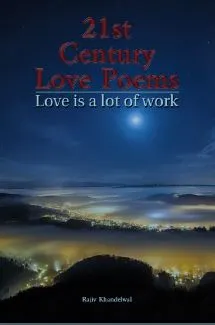
About the Book
21st Century Love Poems: Love is a Lot of Work is Rajiv Khandelwal’s second collection, published in 2013, fifteen years after his debut. The book carries a Foreword by Reginald Massey, Fellow of the Royal Society of Arts of the United Kingdom and Freeman of the City of London, and an Editor’s Preface by Bhupinder Parihar, the Ludhiana-based poet and scholar who had encouraged Khandelwal’s earliest writing and who returns here as a close reader of his maturing work.
The title states the book’s argument plainly. Love, in these pages, is not the moon-in-June poetry that Massey’s Foreword describes as out of step with a generation of young, upwardly mobile Indians fluent in technology and impatient with sentiment. Khandelwal writes for that generation instead, in a language drawn as readily from Keats and Donne as from HBO romantic comedies and the traffic intersections of an ordinary Indian street. The opening poem, ‘My First Memory of You’, sets the pattern: an evening among inherited furniture and a stack of borrowed poetry, ending with the speaker standing like Dante in church, struck still by a woman as unaffected as Beatrice Portinari. The title poem follows directly, building its case through a list of pleasures the speaker insists are irrelevant, irrational, and pointless, until the joke turns serious and love reveals itself as work after all.
A hundred poems carry this argument forward, through courtship, distraction, broken communication, and abiding desire, tracing one long relationship through all its ordinary and extraordinary weather.
PRAISE AND CRITICAL ACCLAIM
“Rajiv has deftly de-classicalised love and contextualized his love poems with modernistic contemporariness and a rare flavor which lend an aura of extraordinariness to the existential mundanity of today’s tedious technological life.”
Mr Bata Krisha Dey | IAS (Retd); Ex-Secretary to the Govt. of India; Ex-Professor and a major poet and author“Khandelwal’s Love is a Lot of Work successfully covers everything that symbolizes love and affection. The cornucopia of human experiences is dealt with great skill, which ranges from love, nature, humility to nostalgia, remembrances and reality.”
Ramandeep Kaur, Kamaldeep Kaur | Research Scholars, Punjabi University, Patiala“The verses of Rajiv Khandelwal speak to today’s technocrats in a language that they will comprehend and to which they will relate most readily. The poems have an immediacy and urgency. Their sharp laser-like intensity penetrates the head and the heart. Khandelwal is a new voice singing songs of love for the new generation of the new world.”
Reginald Massey | Fellow of the Royal Society of Arts of the United Kingdom and Freeman of the City of London“Rajiv’s poems are solemn, gracious, funny, irreverent at times but astonishingly real! Love stripped conscientiously. Soliloquies documented dauntingly. Loaded with soft inner muse, soulful! Impeccable! Accessible collage of profound artistry. Personal/impersonal simultaneously, yet within Larkin tradition.”
Varindar Parihar | Critic/Poet, Southampton, Hampshire, UKReviewed by
- Dr D. C. Chambial — ‘Khandelwal’s Poetry: A Quest for Eros in Boondocks’.
- Ramandeep Kaur and Kamaldeep Kaur — ‘Love is a Lot of Work’.
- Dr Bhupinder Aziz Parihar — ‘Rajiv Khandelwal’s Love Poetry in Love is a Lot of Work: Poetry of Positive Infinities’ — Click here to read this review.
- P C K Prem — ‘Reflected Images in the Poetry of Rajiv Khandelwal’.
- Dr Som P. Ranchan — ‘Love and Beyond Love’ — Click here to read this review.
- Dr Jayshree Singh — ‘Breaking Conventional Barriers’.
- Dr Harish K. Thakur — ‘Book Review: 21st Century Love Poems’
- Dr Pratibha Verma — ‘Rajiv Khandelwal’s 21st Century Love Poems: Love is a Lot of Work’.
Rajiv Khandelwal's Love Poetry in Love is a Lot of Work
A critical appreciation of 21st Century Love Poems: Love is a Lot of Work by Dr. Bhupinder Aziz Parihar.
In the early twentieth century, T. S. Eliot introduced a new love ethos with his ‘Love Song of J. Alfred Prufrock’. It was a different kind of love lyric, rooted in contemporary socio-cultural concerns. With striking images and irony, Eliot introduced a speaker, nervously timid, unable to make any meaningful gesture that might free him from empty rituals. Both the setting and the use of dramatic monologue anticipate new tendencies and modes in modern poetry: a new emphasis; absence of clear-cut moral positions; subversion of omniscient literary expression; dynamic imagery; and a preference for fragmented poetic forms. Thus, modernism demanded intensity and questioned the conventional philosophy of poetry as a transparent mode of representing reality.
Even in postcolonial Indian English Poetry, poetic language is emphasised and foregrounded to an extent that language becomes the most important point. Free verse, innovative structures, and eclectic modes of perception and expression are introduced by way of departure, in line with contemporary life and living.
In continuation of postcolonial poetic culture, Rajiv Khandelwal foregrounds form over the thematic of love and opens up for questioning the economy of language. As Linda Williams remarks, “Poetry scrutinizes the form, the contours, the material of the mask of language” (The Poetry of Modernity). Khandelwal sometimes chooses words not for their meaning, but because they sound and portray a reality, and evoke the “thingness of things”:
…. Nothing much happening Except She has no time Has a lot to finish I recession hit Wait For the finish As a poet of romantic realism, Rajiv Khandelwal seeks to establish form and substance as distinct textual dimensions: …And in the midst of all chaos You sitting Unaffected Like Beatrice Portinari And I Standing Like Dante in church (‘My First Memory of You’, p. 1) The old man In one of his business discourses Said, Son! To learn Successful business strategies One must learn to entangle himself Deep into the subject Before trying To disentangle … I became A successful businessman Using the above technique The trouble is that in love Using the same technique While thinking of you I frequently Tie myself into knots And each knot Ties itself Into further knots As I struggle In vain To untie Myself
Realism in literature in its pristine sense tends to present experience as it is. It is concerned with description rather than invention. Rajiv Khandelwal invents and documents contemporary life in a direct, low-key, unrhetorical mode, thus reproducing a colloquial flavour.
This is an area largely unexplored in contemporary Indian English poetry. This is a mode of rational observation that provides an authentic texture to Khandelwal’s love poetry. It is his native version. His lover is not a lotus-eater filled with languorous content, reluctant to continue his journey. His verbal music does not withdraw him from the world of work and competitive struggle:
… Large, grey clouds Appearing dark Hover Over the venue Where Local priests wed frogs In mystical weddings As frogs croak, peacocks cry The papiha sings its song of love Confused cows Lie perplexed in parched plains As half-naked women Perform plow rituals A lone village bard recites his laments Like them I pray …. In his case, beauty does not obliterate other considerations: … You smiled Ruffled my hair And loneliness chipped away These days I find my fingers ruffling my hair I did not let The grave Containing the past Darken my door … Later, I found Your dewed hanky (The one you gave me) Wet and beseeching Lying next to my helpless hands … Framed concerns Sneak in For likely affiliations With dirty linen moments
The poet disdains the morbid aspect of love, yet he recognises its beckoning profundities. This, perhaps, completes his poetic rehearsal in the realm of amorous mirth and myth:
… You sound the death knell And I wonder how You can be so shy So cute Yet the biggest serial killer Of my elfin frenzy … Well, you did what you had to But doesn’t it ever bother you When my heart goes wild You do nothing … Must I die a hundred deaths And you launch a thousand ships?
The myth of love gives a kind of order to Rajiv Khandelwal’s poetic constructions and creates a reader-friendly contextual archive. It is within the matrix of this archive that the reader grasps the intensities of love experiences, along with the poet’s literary erudition, the imagistic thrust, brevity of treatment, and concreteness of detail:
… That now you are here For the life of me I can’t figure out Where you fit in In all the comings and goings Of the same old things … the book ‘Games People Play’ And the bookmark you gave me Have an aged, tired look Often I find myself in the dark Playing make-believe games Tossing the coin And betting “Did she or didn’t she?”
In today’s world of speedy communication, communication seems to have collapsed. Talking to the self seems to have led to an urgent need for more and more communication, which ultimately is transformed into an illusion. In a digitised world, “I Love You” has lost its freshness and enchanting quality. It is mere frozen ink, not an utterance:
… For if Maths Can integrate My definitive love Divide it By yours – Zero And Q.E.D. … Then I have to be a modern Euclid For developing an algorithm To fill some Extended empty spaces … … Fresh beats in life’s pleasures Bid a corporate takeover As prepackaged emotions Get new marketing propositions … The “I” Struggles to be “We” The battle began And once again I became the Greek king Tantalus He who dined with the gods
A love poem is defined as a poem addressed to a lover, about the lover, or about love itself. Love has through human history exerted primary influence upon poetry. It includes love for poetry itself. Ezra Pound once observed:
What thou lovest well remains The rest is dross John Keats in ‘To Fanny Browne’ writes: This living hand, now warm and capable Of earnest grasping … -see here it is- I hold it towards you
Pound wrote his lines in a prison cell in 1945, and Keats somewhere near 1810. As love poetry flows into the twenty-first century, conventions of love persist, though love of conventions may not. We are not living in a classical age, not even an age of ‘heap of broken images’. We are witnesses to ‘broken images’. The heap that gave some unity and order to broken images is gone. Only images remain.
A poet is free to do anything in poetry, but not everything. In Rajiv Khandelwal’s love poetry, it is love that provides structural unity. His love poems bear similarity to both prose and verse. It is rather hard to contend that anything written in lines, metrical or otherwise, is verse. Poetic dictates do not make a poem necessarily a poem.
In his introduction to Little Poems in Prose, Baudelaire asked: “Which of us, in his ambitious moments, has not dreamed of the miracle of a poetic prose, musical, without rhyme and without rhythm, supple enough and rugged enough to adapt itself to the lyrical impulses of the soul, the undulations of the psyche, the prickings of consciousness?”
Rajiv Khandelwal obversely expresses a personal emotion and suggests a real person thinking out loud. Largely a poet of vestigial memory, his poems tend to be quiet, inward, reflective, and mental. Memory is a source of poetry as it supplies the necessary raw materials of imagination. As a kind of mental ingestion, memory is akin to saving a file on a computer:
My first memory Starts with the party At your house… Even now When I see blooming, swaying flowers I think of you … A subtle knock Echo of fading footsteps Sounds of laughter I hope its you … Let me look back Without malice Without mischief … Myriad images From enforced nostalgia Surfaced Toxically therapeutic
Love is a Lot of Work is a text with so many voices. The poet borrows images from nature and politics in order to enhance aesthetic impulses. He knows that one must act quickly on one’s romantic impulses because life is short. Here, the romantic impulses are not mere romance. They grumble, tarry, encounter, and redeem with their cathartic virtue:
When I find Raindrops on my cheeks On a clear sunny day And the breeze of emptiness Stirs mortal passions … … And in that split second The sweet-smelling sweet-scented smell The enigmatic amor smile The braided, bound wavy tresses Precipitated the mawkish heart To beat out of rhythm … Hence I must salute the man Who did not ride, but ran … After all What is there to live for If one has nothing to lose … Spark of the muse Makes the pang Less soft, less inviting … Tread carefully, my friend We have to rebuild life … For now It is the supermarket That makes me happy … No. Darling It is not about My falling in love With another woman It is the business deal I am finalizing today
This is a tribute to love, a generation of ideas for love poems. And the language of love continually evolves. Rajiv Khandelwal knows well that loving is taking a risk. His lover’s voice has multiple tones: philosophical, passionate, irritated, introspective, candid, plaintive, defensive, imploring, resigned. It is erotic but rarely gratuitously so. The poet adjusts his voice to enhance the obsession that is the core of a love poem. The love imagery is so mixed that a symphony celebrating the relationship is created:
… And that’s where Lies the delicious irony Even your air-kissing ghost Knows How to be a tarty tease … Nervous thrill Springs from within As images grow The cooing of mating birds Gives free rein To tender cravings Catalytic sight Wheels in excitement Allures Wakens candle-lit desires To construct the rainbow
This is evident in the poems constructed on absent love. They display their excellences in solitude. In these poems, gesture becomes genre:
… What is of dying importance Is why She did not communicate Today … Nothing has changed Except I no longer go the theatre Where in the dark We held hands … Passing through stages of destruction Fight For inheritance of pain … Be gentle my dear Let lost happiness Remain lost … Opens itself To charges of solicitation When your look-alike on the motorbike Speeds by
Too many love poems sound too sentimental or sweet. Love poets often develop a complex that they are speaking to the ages, which is nothing but romantic nonsense. Rajiv Khandelwal has no such agenda or illusion. His mission as poet is to “redeem the shards into glittering diamonds” (‘Broken Relationship’). With a huge sense of person, place, and setting, he embeds allusions and references into contemporary contexts. His poems do not end in proverbial wisdom, as he knows a love poet is no sage. He is a common human doing something to language in his quest to know what else and what more lies there.
Baudelaire in ‘Get Drunk’ wrote … what time is it now? And wind and wave, star, bird and clock will all answer: “It’s time to get drunk! Yes, if you are not merely to live out your lives as the martyred slaves of Time, make sure you stay drunk, too! With wine, poetry, or virtue — whatever you prefer.”
Rajiv Khandelwal prefers poetry, knowing well that if love is a lot of work, so is poetry. To stay alert for words, images, references, and perceptions that might coalesce into the nucleus of a poem is his forte. With rare élan, he positions words detached from their familiar moorings so that something unprecedented is unveiled:
… the un-worded Disappeared as words Appeared as meaning Live in exile In poetry journals I hold my breath tightly Hoping You read
Love and Beyond Love
A scholarly review by Dr Som P. Ranchan exploring the depth, philosophy, and poetic craftsmanship of 21st Century Love Poems: Love is a Lot of Work by Rajiv Khandelwal.
Rajiv Khandelwal is a major poet. P. Lal once said to this writer that India does not have a major poet; he even added that we do not have even a minor major poet, though we may have a crop of minor poets. P. Lal should know, because he brought to the attention of readers practically every known poet who is now canonised and taught in courses in Indian English Poetry. He published every canonised poet: Shiv Kumar, Nissim Ezekiel, Dom Moraes, Ramanujan. He was the first to draw attention to the flight of the birds fluttering in the sky. Unfortunately, P. Lal is now no more, and no one has taken his place to draw attention to the new voice.
Rajiv Khandelwal is a major poet, and this fact has to be emphasised through reiteration for the following reasons. Perhaps he is an extraordinary, many-layered love poet. He goes deeply into man-woman relationships and presents many sides of women: her sensuality has the power to draw man and involve him in the eternal game of love. The Poet Khandelwal responds to love in every aspect.
He submits to its alchemy in poem after poem, stoically and in a Sufic way; he does not write off women because she promises much more than what she delivers. Despite hurt and disappointment in his love poetry, he remains loyal like a true lover and continues to burn incense to her beauty, nakhara and nazakat. As a poet he craves for fusion and communion and is grateful for the moments vouchsafed; he frees himself from possessiveness though he always longs for her presence in critical moments of loneliness and solitude. His love poetry should be, to begin with, the subject of monographs. It is rich in fulsome expression and also understatement; it is replete with binaries and paradoxes. Despite abandonment and anguish, it is not for him to write off the beloved. The reader is advised to read his love poetry many times over, to acquaint himself with the whole spectrum and range of emotions.
In his love poetry, he is not concerned with beauty only but feels the suffering of women in domesticity and in patriarchal society. From that perspective he can be called a poet of womanhood, a feminist poet. He brings to bear all the thematics of love: jouissance, actual and imaginal. Imaginal is being used in a special sense, referring to the manifestations of the archetype of love, which can never be exhausted as an archetype.
As a love poet he does not bring to bear on the archetype of Love any doctrinaire of tantra, because he is not into systems, but his sensibility is both tantric and Sufic in this matter, and stoic withal. Because he is so deeply into the theme of love he does not sink himself into the deeps of introversion; he remains very much in the world, fully cognizant with what is happening in his country and in the world at large. Love also becomes the theatre of concern in the external collective, which makes him a doughty satirist exposing cant and hypocrisy not only in relationships and in institutions but in every sphere of life.
He is critical of casteism, communalism, the criminalisation of politics, the commercialisation of education, and the commoditisation of religion and spirituality, and he packs a knockout satirical punch again and again. His satire is not into lampooning and invective but ridicules and exposes. It is corrective and draws attention implicitly or explicitly to universal humanism without authoritarianism.
Not only is he a love poet of many nuances, but he is also a poet of society in every aspect of its functioning. What separates him from other poets, as a love poet and as a satirist, is that he has a unified sensibility: sensing, feeling, thinking, intuiting. All the functions revel in memories and associations, and he draws language from diverse sources: from myths, from films, from newspapers, from philosophy, from business, from science, from mathematics. He has the ability to stretch his associations to the limits of ingenuity. In this he reminds one of the metaphysical poets, but unlike them he blends the romantic and the metaphysical, because he comes from a culture that romanticises and metaphysicalises both. If one adds to this cultural mixture a unified sensibility and the yeast of imagination, one begins to understand something of his poetry.
The key to his facility with writing in general and poetry in particular, and his prolificacy, which he is beginning to evidence in good measure, has to be sought in the following facts. He is now centroverted. His two principal functions, sensation and thinking, which have been in consciousness and which he has used professionally and in the gamut of relationships, are extroverted in their attitudinal orientation to life. The other two auxiliary functions, feeling and intuition, are in the unconscious and they are introverted. The introverted feeling function, however, is in close proximity to the thinking function; resultantly, even in his poems which are imbued with feeling, thinking makes its own inputs, leading to a complex, sometimes convoluted orchestration of thematic and concomitant motifs. Intuition, which is introverted and in the unconscious, has become developed because of writing. Because of this functioning, extroversion and introversion somewhere along the line began to synergise. He has become, as a poet, a four-legged horse, a four-wheel drive. In comparison, by and large most Indian poets are at best three-legged. This centroversion has given to him a rich quarry, both wide and deep. At this point a caveat must be entered: he has so far only scratched the surface of this quarry as a love poet in particular. When he enters the subject of love through a rich many-layered engagement, through conjunction, that will be the beginning of great love poetry.
Coniunctio is the basic postulate in Tantra. Coniunctio begins the activation of what is called by Rama Rao as kundalini, which awakens the hidden occult magma of consciousness and energy. Great poets such as Walt Whitman, Robert Graves, D. H. Lawrence, Kalidasa, and Bhav Bhuti had an active kundalini in the vernacular aspect. Then the poet will go beyond the girl on the motorbike, the girl seen in the supermarket, and other related sensory attractions. Not that they will be over, but from the alchemical perspective as a poet and a person he will achieve distinction from that brew. Resultantly, love poetry will take on the accents of bardic chant and catalogue-sacred liturgy.