A Monument to Pigeons
A Monument to Pigeons (2013), Rajiv Khandelwal’s third poetry collection, marks a deeper, more emotionally charged exploration of family, women’s lives, marriage, and human relationships.
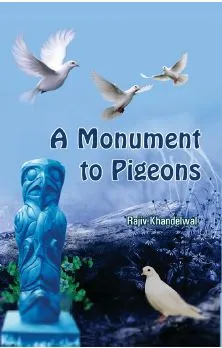
About the Book
A Monument to Pigeons is Rajiv Khandelwal’s third collection, published in 2013 by Global Fraternity of Poets, the same year as Love is a Lot of Work. The book carries an Introduction by Dr Som P. Ranchan, the mentor who had first encouraged Khandelwal’s writing back in 1996, and it is dedicated to his mother Lalita, his wife Seema, and his two daughters, Vertica and Vernica.
Ranchan’s Introduction sets the book apart from the two collections that came before it. Without breaking from the concerns of Conch Shells and Cowries or Love is a Lot of Work, A Monument to Pigeons goes further into family, women’s experience, and the difficult territory of marriage and its aftermath, in a style Ranchan calls denser and more charged with feeling than the earlier work. The title poem, an ars poetica that doubles as a quiet manifesto, sets out the standard the whole book holds itself to. A poem may have beauty of form and emotive expression, Khandelwal writes, but if its words do not combust on the page, if they fail to arouse kindred emotions or refer to anything beyond, then for all its craft it remains no more than a monument of interest to pigeons.
Ninety-six poems make up this collection, the third in a body of work that Ranchan, writing as both mentor and reader, describes as having matured and found a distinct and respected place in Indian English poetry.
PRAISE AND CRITICAL ACCLAIM
“This is a collection of 96 poems handling a good variety of themes. In today’s literary scenario, where copy-paste culture is gradually killing the creativity, arrival of fresh and natural poetry like Khandelwal’s is always welcome.”
Dr Ashish M. Srivastava | as published in The Anvil No. 2, July 2015“A Monument to Pigeons deals with a wide range of themes from love, pity, pain, sorrow, change, religion and more significantly the contemporary issues. The book offers a bunch of interesting poems and one wades through the volume with a smiling face.”
Dr Harish K. Thakur | Editor, Conifer Calls“Khandelwal’s poems demonstrate a fluidity and multiplicity of meaning. The poems blur boundaries, destabilize concepts, and deconstruct societal norms, highlighting the complexities of human experiences.”
Imraan Nazeer | ‘Unveiling the Complexities’ — PJAEE, 20 (2) (2023)Khandelwal’s mental sweep is vast and art smooth. At times the poet reminds of Kamala Das.
Dr Naqui Ahmad John | Academician, Editor, Poet, Critic“A Monument to Pigeons is a very rich volume; dealing with family poems, love poems and women-centric poems with a focus on their predicament socio-culturally and in the family dynamics. The difference from the earlier thematics and semantics is in more sensitive and deeper engagement with the issues in a style which is more dense and charged with emotion, resultantly this work is imbued with deeper sensibility than the earlier two works.”
Dr Som Ranchan | Scholar, Poet, Novelist, Literary Critic“This volume seems closer to the heart, quenching the poetic thrusts of the readers. Lucidity of language and enchanting style of versification feature Khandelwal’s poems.”
Dr Soumitra Chakraborty | Book ReviewReviewed by
- Dr Soumitra Chakraborty — ‘Book Review’ — Click here to read this review.
- Imraan Nazeer — ‘Unveiling the Complexities: A Deconstructive Analysis of Rajiv Khandelwal’s Poetry Collection A Monument to Pigeons’ (PJAEE, 20(2), 2023) — Click here to read this review
A Monument to Pigeons: A Critical Review
A critical review of A Monument to Pigeons by Dr. Soumitra Chakraborty.
A Monument to Pigeons by Rajiv Khandelwal presents the travel of a poetic soul across various themes and connotations. Khandelwal has composed several books of poems, but this volume seems closer to the heart, quenching the poetic thrusts of the readers. The poems dwell on issues and narratives divergent in the present society and, at the same time, satisfy one’s sensuous pleasure and aestheticism. When poems like ‘Pain’, ‘Pain and You’, and ‘Anguish’ portray grim pictures of society and attempt to create public awareness, poems like ‘You and Me in Love’, ‘Rickshaw Ride’, ‘New Dawn’, and ‘Poetry’ acquaint the readers with the poet’s romanticism and aestheticism and sensuousness. These varieties of substance, amplified in lucid terms, make the readers enjoy and engage with the collection.
India proudly garners her old and traditional culture of ‘unity in diversity’. The country is the abode of people belonging to diverse cultures, castes, and creeds, but unity amongst them has made the land great. This historical and ancestral Indian aspect has been the theme and subject of literature down the ages. Khandelwal has not set aside this aspect from his poems. The poem ‘Anguish’ presents a small but very touching image of communal integrity. A little boy, who is incapable of walking steadily, helps an old mullah cross a busy traffic road with his tiny shoulder:
The blind old mullah’s benefactor The turbaned spastic boy, a spectator Hardly able to manage his own walking Helped him cross the busy traffic crossing Offering support with his tiny shoulders.
The scene may look insignificant, but it carries broader significance from the point of view of social integration. Maintaining social dynamics has been challenged repeatedly in India, leading to conflicts amongst Indians of varied caste, cultural, and religious identities. Most of the time, provocations from external forces are duly responsible. This superficially small image can be a compelling advertisement for communal integrity in Indian society.
At the end of ‘Anguish’, the poet expresses anguish towards the filmmakers for their indifference to the noble scene and towards the provocateurs who conspire to spread communal hatred in society for personal gains and political mileage:
I hope the film makers Made no recordings Of this set and particular situation For the zealots From this public display Event from these exceptional happenings Drum some communal hate Dream some action And make their murderous play
Khandelwal’s poems are replete with diverse social issues, problems, and customs. India has advanced technologically and economically in the twenty-first century, but economic progress seems not to have reached every corner of the country. The poem ‘Pain and You’ eloquently and unambiguously unveils and elucidates a grim social issue. The poet has shown how a poverty-stricken woman has been bound to sell her only girl child for money:
Like the beggar women Who for want of food to feed Sells her sole girl child
The narrator in the poem is shown as chronically sick and in intolerable pain. However, his physical pain has been subdued by the mental pain caused by the incident described. Grief-stricken incidents touch those who have hearts to feel and minds to think. The poet possesses both; that is why his narrator felt mental pain despite the physical pain in his body. These lines from the same poem confirm Khandelwal’s commitment to society:
On such compulsorily confined to bed days When the pain moves from here to there Both physically and mentally Mostly that’s when Pain stirs subconsciously Shapes your thoughts
Some of the poems have depicted Rajiv Khandelwal as a man close to the soil of his land. The poet narrates the joy of a rickshaw ride in ‘Rickshaw Ride’. When the poet’s car broke down, he gladly took a manual rickshaw to reach his destination. What is noticeable here is his attitude. In place of Khandelwal, another person might not have accepted the situation gladly; he accepted it in a joyous mood, as if the situation were a gift rather than an inconvenience. The vivid and sensuous descriptions of the rickshaw ride uphold him as a son of the soil. Not only ‘Rickshaw Ride’, but several other poems bear testimony to Khandelwal’s intimacy with the life around him.
Khandelwal’s romanticism and sensuous descriptions are evident in many poems in this book, including ‘New Dawn’, ‘Poetry’, ‘Rickshaw Ride’, ‘You and Me in Love’, and ‘Bad Timings’. In ‘Rickshaw Ride’, the poet narrates his sensuous feelings about the ride, remembering his old days when he took a rickshaw with his dear one during the rainy season to reach an auditorium to see a film:
When I close my eyes I sometimes sense That curious interplay Of chilly weather Your bewitching scent My searing thighs I remember As if it was yesterday How When you had shifted slightly sideways Your bosom’s fullness had at first brushed Then sunk inches into my bicep…
In ‘You and Me in Love’, the poet’s fascinating description of love touches the heart. He defines love in his own terms across varied situations: sometimes set on a sofa seat, sometimes in a car, and sometimes during a long walk:
Love is about sitting at your specific sofa seat Willingly loosing remote To view English war movie When a popular Hindi serial was the social must see
Lucidity of language and enchanting style of versification feature Khandelwal’s poems. The use of simple language and analogies will definitely arrest the reader’s attention. Some words and phrases used in the poems carry layers of meaning: ‘zealots’ in ‘Anguish’, ‘enveloped in acrid odour of funeral’ in ‘A New Dawn’, and the analogies used in ‘You and Me in Love’ to define love are genuinely fascinating. Khandelwal’s handling of words, phrases, and analogies has made his poems popular and accessible to readers.
Unveiling the Complexities: A Deconstructive Analysis of Rajiv Khandelwal’s Poetry Collection A Monument to Pigeons
A deconstructive study of A Monument to Pigeons by Imraan Nazeer, Muhammad Arsalan Siddiqui, and Hafiz Imran Nawaz.
Abstract
The objective of the research is to uncover the underlying structures and subversive elements present in Rajiv Khandelwal’s poetry collection A Monument to Pigeons. This is achieved through a deconstructive analysis, which aims to deepen comprehension of Khandelwal’s artistic vision, language, identity, and societal engagement. The research critically examines a selection of ten poems from the collection and incorporates insights from notable literary theorists, employing the deconstruction theory proposed by Derrida. The research finds that Khandelwal’s poems challenge fixed interpretations, disrupt language conventions, and encourage exploration of alternative perspectives. It is concluded that Khandelwal’s poems have fluid and multiple meanings, challenging fixed interpretations and inviting readers to question assumptions.
Introduction
In the realm of literary analysis, deconstructive approaches have proven to be effective in unravelling the intricacies and hidden layers of meaning within literary texts. This research study focuses on applying a deconstructive analysis to explore the depths of Rajiv Khandelwal’s poetry collection, A Monument to Pigeons. Rajiv Khandelwal is a renowned poet whose thought-provoking and evocative poetry has captured the attention of readers. A Monument to Pigeons is a significant work in Khandelwal’s oeuvre, published in 2013 by the Global Fraternity of Poets. By subjecting this collection to a deconstructive analysis, this study seeks to shed light on the underlying structures and significations embedded within Khandelwal’s poetic work.
Deconstructive analysis, rooted in the work of Jacques Derrida, challenges the traditional notion of stable meanings and fixed categories (Derrida, 1976). It aims to expose the underlying assumptions, contradictions, and hierarchies that shape our understanding of phenomena (Hawkes, 2003). The application of deconstructive analysis has been witnessed across various disciplines, including literary studies, philosophy, sociology, and cultural studies. Its versatility lies in its ability to reveal the intricate interplay between language, power, and knowledge production (Hall, 1997).
In order to relate to Khandelwal’s poem, the reader must bear in mind what Emily Dickinson wrote long ago: “I know nothing in the world that has as much power as a word. Sometimes I write one, and look at it, until it begins to shine.” Taking this statement into consideration, Khandelwal’s choice of diction, and the title of the poem WORD, solitarily appended, is highly significant as it acts as a signifier and depicts loneliness linked with the signified past-tense verb ‘searched’
Research Statement
The research aims to undertake a deconstructive analysis of Rajiv Khandelwal’s poetry collection, A Monument to Pigeons, in order to unveil the intricacies and complexities embedded within the work. Through a close reading of selected poems, rigorous analysis of linguistic choices, and incorporation of insights from prominent literary theorists, the research aims to provide a comprehensive understanding of the multifaceted nature of Khandelwal’s poetry, contributing to the field of contemporary poetry analysis and inspiring further scholarly dialogue.
Research Objectives
The research sought to achieve the following objectives:- To unveil the underlying structures and subversive elements within Rajiv Khandelwal’s poetry collection, A Monument to Pigeons, through a deconstructive analysis.
- To deepen understanding of Khandelwal’s artistic vision, language, identity, and societal engagement by critically examining select poems from A Monument to Pigeons and incorporating insights from prominent literary theorists.
Significance of the Study
This study holds significant value as it offers fresh insights into the contemporary poetry landscape by undertaking a deconstructive analysis of Rajiv Khandelwal’s poetry collection, A Monument to Pigeons. By unravelling the intricacies and complexities within the work, it deepens understanding of Khandelwal’s artistic vision, language, identity, and societal engagement. The study sheds light on the subversive elements, linguistic choices, and intertextual references, opening new avenues for interpretation and fostering scholarly dialogue. It enhances appreciation for Khandelwal’s poetry while showcasing the potential of poetry to challenge societal norms and power structures.
Delimitations
This research is delimited to a comprehensive and exploratory analysis of Rajiv Khandelwal’s poetry collection, A Monument to Pigeons, employing a deconstructive approach. The analysis is limited to a selected set of ten poems from the collection, employing a systematic sampling method by analysing every tenth poem, beginning with the fifth poem. The theoretical framework for the analysis is based on Derrida’s theory of deconstruction. The research adopts a descriptive and qualitative approach.
Literature Review
Deconstructive analysis is deeply rooted in the work of Jacques Derrida, particularly his seminal texts Of Grammatology (1967) and its translation (1976). Derrida’s ideas challenge the traditional notion of stable meanings and fixed categories, proposing that language is inherently unstable and riddled with contradictions (Hawkes, 2003). Scholars like Derrida and Roland Barthes have employed deconstruction to question the authority of authorial intent and challenge conventional interpretations of literary works. By examining the tensions and contradictions within texts, deconstructive analysis exposes the multiplicity of meanings and opens up space for alternative interpretations (Butler, 1990). Additionally, deconstructive analysis has been influential in postcolonial literary studies, as it deconstructs dominant narratives and exposes the power dynamics inherent in colonial discourses (Spivak, 1988).
Rajiv Khandelwal’s poetry collection, A Monument to Pigeons, has garnered attention in the realm of contemporary poetry for its intricate layers of meaning and subversive elements. In his debut book, Conch Shells and Cowries, Khandelwal showcased his role as a social reformer, using satire to expose social evils and hypocrisy (Ranchan, 2013). His collection Love is a Lot of Work explores the complexities of love through a symphony of one hundred poems, exhibiting realism, delicate language filled with creative figures of speech, and satirical elements (Ranchan, 2013). Despite the extensive application of deconstructive analysis across various fields, there is a noticeable research gap when it comes to its application to contemporary poetry, particularly Khandelwal’s collection. This research aims to fill that gap.
Methodology and Theoretical Framework
This comprehensive and exploratory research adopts a descriptive and qualitative approach, focusing on a selected set of ten poems from A Monument to Pigeons. A systematic sampling method was employed, selecting every tenth poem from the book for analysis, beginning with the fifth poem. The theory of deconstruction, as expounded by Derrida in 1967, serves as the theoretical framework. Through the application of deconstructive analysis, this research seeks to unravel the underlying structures, meanings, and subversive elements within Khandelwal’s poetic expressions.
Data Analysis
Analysis of First Poem: ‘Not Always’Instability of Meaning: The poem begins by questioning the fixed notions associated with poems. The phrase “Not always does the poem” introduces an element of uncertainty and challenges the assumption of consistency in the meaning of poems, undermining the reader’s expectation of a clear and definitive interpretation.
Subversion of Expectations: The poem subverts conventional imagery associated with poetry, presenting a contrast between light and darkness symbolised by the “dagger of sunlight” and the “flint-stone of moon.” Typically, sunlight and moonlight evoke positive or romantic connotations; the poem challenges these preconceived notions.
Disrupting Binary Oppositions: The poem disrupts binary oppositions traditionally associated with poems, such as truth versus fiction or reality versus imagination. The statement “A sly epic love poem is reviewed as fiction” indicates that the distinction between fact and fiction is not fixed or stable.
ining Authorial Intent: The poem challenges the assumption that a poem seeks to be understood or demands compassion, asserting: “Not always does the poem / Not ask for understanding / Compassion, as its dying wish.” This disrupts the expectation that the poet’s intention is to communicate a specific message.
Analysis of Second Poem: ‘Wish You Were Here’Instability of Presence and Absence: The poem presents a complex interplay between presence and absence. The speaker’s mother is physically absent due to illness, yet her presence is invoked through memories and desires, destabilising the binary opposition between presence and absence.
Disruption of Language Conventions: The poem disrupts conventional language conventions, creating a fragmented and disjunctive narrative. The fragmented phrases resist linear coherence and open up space for multiple interpretations.
Multiple Interpretations of Identity: The poem introduces a female doctor who is described as “strangely disarming” and likened to a Barbie doll, disrupting traditional expectations of a doctor’s appearance and challenging fixed notions of gender and identity.
Desire for Connection and Intimacy: The speaker expresses a longing for connection through phrases like “clingy aching-void” and “Wish you were here,” highlighting the human need for companionship and challenging the assumption that autonomy is the ultimate goal.
Analysis of Third Poem: ‘A Poem Accomplished’Instability of Poetry: The poem challenges the conventional understanding of poetry as a fixed and complete entity. The repetition of “Revisits” suggests an ongoing process, undermining the notion that a poem is a final product.
Disruption of Language Conventions: The poem disrupts conventional language conventions through its use of similes, comparing the poem’s actions to adolescents frequenting brothel calls, a lover’s dreams, and a child’s play with clay, challenging the reader’s expectations.
Reconfiguration of Meaning: The poem reconfigures meaning by associating it with illumination, instruction, and comfort, challenging the conventional notion of poetry solely as a source of enjoyment and positioning it as a transformative and meaningful experience.
Destabilisation of Interpretation: The poem destabilises interpretation by suggesting that it can cure a “bore someday,” challenging the assumption that poems are always enjoyable and inviting readers to consider alternative perspectives.
Analysis of Fourth Poem: ‘Conversation Overheard at the Employment Exchange’Destabilisation of Employment Norms: The poem destabilises conventional notions of employment, challenging the assumption that joblessness is solely due to personal incompetence or a lack of opportunities. It exposes the contradictions and complexities of the employment landscape.
Disruption of Language Conventions: The poem disrupts conventional language conventions through the use of informal and confrontational language, challenging the reader’s expectations of polite discourse and prompting questions about the power dynamics embedded in language.
Deconstruction of Social Structures: The poem deconstructs social structures by questioning the legitimacy of the system and exposing the contradictions within it, challenging fixed notions of progress and power.
Analysis of Fifth Poem: ‘Plaint’Destabilisation of Relationships: The poem destabilises traditional notions of familial relationships. The troubled father’s anguish arises from the fact that his own son desires to kill him, subverting the conventional expectation of a loving and protective bond between father and son.
Deconstruction of Identity: The poem deconstructs the father’s identity by highlighting his emotional and psychological state. The father claims to have already been dead for many years, suggesting a profound sense of inner turmoil and challenging the assumption of a stable and coherent self.
Ambiguity and Multiple Interpretations: The poem’s ambiguous language and imagery create space for multiple interpretations, leaving room for readers to engage in open-ended questioning of fixed meanings.
Analysis of Sixth Poem: ‘Not Even in Dreams’Destabilisation of Wishes: The poem suggests that wishes do not always come true, even in dreams, deconstructing fixed notions of desire and opening up possibilities for alternative interpretations.
Deconstruction of Time: The poem deconstructs the notion of time by juxtaposing moments of hearing echoes from the past with the realisation of wishes, challenging linear and sequential understandings.
Multiplicity of Interpretations: The poem’s language and imagery create space for multiple interpretations, allowing readers to engage with the poem from different perspectives.
Analysis of Seventh Poem: ‘Black Strand’Destabilisation of Inspiration: The poem destabilises conventional notions of inspiration. Instead of seeking inspiration from grand or profound sources, the speaker finds inspiration in mundane and overlooked details, challenging fixed ideas of what can inspire creativity.
Deconstruction of Perception: The poem deconstructs perception by blurring the boundaries between reality and imagination. The speaker’s fixation on the black strand of hair leads to a dream-like state, challenging fixed notions of objective reality.
Multiple Interpretations: The stains and cobweb-like strands on the ceiling can symbolise decay, neglect, or the passing of time. The black strand of hair can be seen as a symbol of desire, fascination, or obsession. This multiplicity encourages readers to engage with the poem from different perspectives.
Analysis of Eighth Poem: ‘Writing Poetry — The Painter’s Way’Destabilisation of Emotions and Influence: The poem destabilises the conventional approach to writing poetry by suggesting that emotions should not be splashed like spin art or spatter art paintings, and urges writers not to be influenced by fantasy, logical thinking, or the theory of form.
Deconstruction of Form and Visual Overloads: The poem deconstructs the notion of form and visual overload in poetry, suggesting that the poet should “skin the word layers” and “slice the visual overloads” to create a new experience, challenging traditional notions of poetic structure.
Analysis of Ninth Poem: ‘No Words’Destabilisation of Communication: The poem destabilises conventional communication by highlighting the limitations and inefficiencies of verbal expression, questioning the fixed assumptions and expectations associated with language.
Disruption of Language Conventions: The poem disrupts conventional language conventions by focusing on the unsaid, suggesting that there is meaning and fascination in what is not explicitly expressed, challenging the conventional notion that words are the sole carriers of meaning.
Analysis of Tenth Poem: ‘I Think’Destabilisation of Time: The poem destabilises the conventional notion of time by suggesting that time can be stretched or distorted. The image of the grandmother on her morning walk, stretching time like she stretches her body, challenges the fixed understanding of time as linear and sequential.
Deconstruction of Meaning and Time: The poem deconstructs the notion of meaning and time by blurring the boundaries between past and present. The image of the washed bed-sheet flung on the plants and the reference to an hour ago feeling like centuries ago disrupt the linear understanding of time.
Results
The analysis of the study reveals several common themes and techniques employed in the poems. Across the different poems, there is a consistent destabilisation of fixed notions and expectations. The poems challenge traditional ideas of meaning, language conventions, expectations, identity, and relationships. They disrupt binary oppositions, deconstruct social structures, and invite multiple interpretations. By subverting expectations and deconstructing established concepts, the poems create space for alternative perspectives and challenge fixed meanings. This study highlights the innovative and thought-provoking nature of these poems, which push the boundaries of conventional poetry and invite readers to engage with the complexities and uncertainties of human experience.
Findings
Through the deconstructive analysis of the ten poems, several findings emerge. The poems consistently challenge fixed interpretations and disrupt language conventions, inviting readers to question assumptions and consider alternative perspectives. They blur boundaries, destabilise concepts such as time and communication, and emphasise the fluidity and multiplicity of meaning. The poems subvert expectations, deconstruct societal norms, and highlight the complexities of human experiences. Through fragmented imagery and juxtapositions, they encourage readers to explore alternative modes of understanding. Collectively, these poems exemplify the power of deconstruction to unsettle fixed interpretations, disrupt language structures, and open up new possibilities for meaning-making.
Conclusion
Through a deconstructive analysis of Rajiv Khandelwal’s poetry collection, A Monument to Pigeons, the underlying structures and subversive elements within the poems have been unveiled. By challenging fixed interpretations, disrupting language conventions, and inviting readers to question assumptions, Khandelwal’s poems demonstrate a fluidity and multiplicity of meaning. The poems blur boundaries, destabilise concepts, and deconstruct societal norms, highlighting the complexities of human experiences. The deconstructive approach reveals the transformative power of Khandelwal’s poetry in unsettling interpretations, disrupting language structures, and opening up new possibilities for understanding and interpretation.
The critical examination of select poems and the incorporation of insights from prominent literary theorists have deepened understanding of Rajiv Khandelwal’s artistic vision, language, identity, and societal engagement. The deconstructive analysis highlights the subversive elements, destabilisation of fixed meanings, and exploration of alternative perspectives within his poetry, enhancing appreciation of its depth, impact, and significance.
Recommendations
Recommendations for further engagement with the collection include encouraging ongoing deconstructive analyses to unveil underlying structures and subversive elements, exploring diverse literary theories and interdisciplinary collaborations to deepen understanding, promoting translation and dissemination for broader interpretation, researching artistic influences and cultural context for contextualisation, incorporating creative writing workshops for experimentation, fostering dialogue among scholars and readers for dynamic interpretation, and facilitating ongoing appreciation of Khandelwal’s work.
References
- Barthes, R. (1977). Image, Music, Text. Hill and Wang.
- Brown, A. (2018). Unraveling complexity in contemporary studies. Journal of Interdisciplinary Research, 12(2), 45–62.
- Butler, J. (1990). Gender Trouble: Feminism and the Subversion of Identity. Routledge.
- Derrida, J. (1967). Of Grammatology. Johns Hopkins University Press.
- Derrida, J. (1976). Of Grammatology (G. C. Spivak, Trans.). Johns Hopkins University Press.
- Foucault, M. (1972). The Archaeology of Knowledge. Routledge.
- Haider, A., Nazeer, I., & Ahmad, K. (2022). A deconstructive analysis of the poem Yellow Leaves by M. R. Gohar. Pakistan Languages and Humanities Review, 6(4), 500–507. https://doi.org/10.47205/plhr.2022(6-IV)45
- Hall, S. (1997). Representation: Cultural Representations and Signifying Practices. Sage.
- Hawkes, T. (2003). Structuralism and Semiotics. Routledge.
- Johnson, R. (2020). Deconstruction and Social Theory. Cambridge University Press.
- Johnson, R. (2022). Deconstructive analysis in contemporary literary studies. Journal of Critical Inquiry, 25(3), 112–130.
- Lacan, J. (1977). Écrits: A Selection (A. Sheridan, Trans.). W. W. Norton & Company.
- Ranchan, Dr S. P. (2013). Introduction. In R. Khandelwal, A Monument to Pigeons. Global Fraternity of Poets.
- Smith, E. (2019). Complex phenomena: Exploring the uncharted territories. Journal of Complexity Studies, 15(1), 78–95.
- Smith, E. (2021). Deconstructive analysis in scientific research. Journal of Scientific Inquiry, 37(2), 212–230.
- Spivak, G. C. (1988). Can the subaltern speak? In C. Nelson & L. Grossberg (Eds.), Marxism and the Interpretation of Culture (pp. 271–313). University of Illinois Press.
- Thompson, P. (2017). Deconstructive analysis in cultural studies. Cultural Inquiry, 21(4), 512–530.