Rajiv Khandelwal's debut collection announces a voice simultaneously engaged with the Indian social landscape and alert to the formal possibilities of Indo-English verse. The poems move across satire, love, political observation, and the textures of urban middle-class life in Agra, drawing on a range of classical and contemporary reference that few debut collections sustain. Reviewers noted the collection's engagement with Eliot's literary precepts alongside its unapologetic exposure of social hypocrisy, placing Khandelwal from the outset in the tradition of Indian English poetry that inherits from the West while remaining distinctly rooted in its own ground.
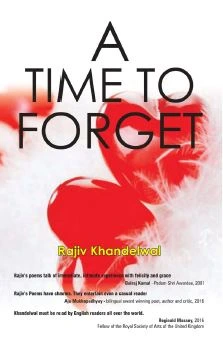
Published fifteen years after the debut, this collection of one hundred poems establishes Khandelwal as a poet of sustained lyric engagement with love in its contemporary, technocratic, and emotionally complicated forms. The poems draw on Greek, Chinese, and classical Indian literary traditions while remaining rooted in the immediate: the unanswered call, the motorbike receding into traffic, the lily pond where silences accumulate. The collection closes with 'Malhar', a poem that compresses the classical Indian monsoon raga, the wedding of frogs, and a lover's plea into eight final words, demonstrating the range of register across which the book operates.
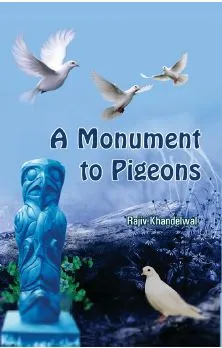
Published in the same year as its predecessor and representing a significant deepening of thematic ambition, this collection extends the love poetry of Love is a Lot of Work into territory that encompasses family dynamics, women's experience in the Indian social order, communal tension, and the nature of poetry itself. The title poem sets the standard the collection holds itself to: a poem whose words do not combust on the page, do not agitate, refuse to stand on their own, is a monument of interest to pigeons only. Dr Som Ranchan, whose critical engagement with the work spans three collections, noted that the difference from the earlier volumes lay in a more sensitive and deeper engagement with issues, a style more dense and charged with emotion.
Of the sixty-seven poems in this collection, fifty-six appeared in established poetry journals prior to publication, a measure of the critical reception the work was receiving internationally. The collection is formally more restrained than its predecessors, working through compressed lyrics and a sustained engagement with the lily pond as a site of memory, desire, and reflection. Indian imagery is woven throughout, including mehendi, sindoor, chimta, peepal, and the Radha-Krishna devotional tradition, alongside philosophical references from Aristotle to Jung, producing a collection that is simultaneously specific in its cultural location and broad in its intellectual reach.
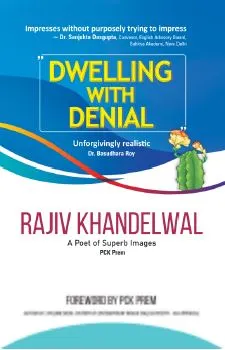
The fifth collection extends the social conscience of the earlier work into its most sustained engagement with contemporary Indian reality, addressing bonded labour, human trafficking, communal violence, surrogacy legislation, and the erosion of civic trust, while maintaining the intimate domestic register that runs through the body of work. Critics described the collection as contemporary, well-crafted, ironic, pensive, and unforgivingly realistic, constituting both a litany of unvoiced dreads and a tribute to the human urge to assert the right to love and heal. The collection also contains a sustained sequence of poems on the nature and craft of poetry that would later form the core of the sixth collection.
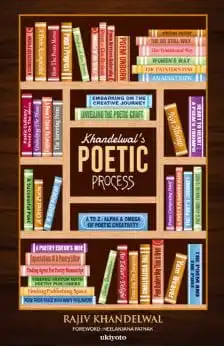
The sixth collection is a departure in conception: all fifty-two poems take the art and craft of poetry as their sole subject, making it one of the rare volumes in Indian English literature to sustain a single thematic concern across an entire anthology. The poems range from the comic, as in the observation that a bad poem is like the fixed-landline-designer-phone placed by the one-flesh-union-wife on the side-table near her side of bed, to the philosophically serious, examining what makes a poem combust on the page, earn applause, survive its moment, and find its way into print. Dr Neelanjana Pathak, in her foreword, situates the collection within a global tradition of poets writing about the making of poems, from Sir Philip Sidney to Ted Hughes to Carol Ann Duffy, and notes that Khandelwal's engineering background likely informs the precision and structural clarity with which he handles the subject.
Dedicated to his father's memory and to his mother in her ninetieth year, the most recent collection marks a significant thematic shift toward mortality, ageing, grief, and the textures of a life lived fully and examined honestly. The poems range from the tenderly observed, as in a mother who wakes in the small hours to listen to her grandson singing on WhatsApp across time zones, to the politically urgent, addressing surrogacy legislation, radicalization, cyberbullying, and the slow erosion of human connection in a digitally mediated world. Reviewers across India and abroad have described the collection as the work of a mature poet working sensitively with language and images, noting that everyday situations undergo dramatic transformation in Khandelwal's hands, the familiar rendered startlingly fresh.